One of the reasons people choose a tankless water heater is that there is no big storage tank to fill with sediment or eventually rust through. That does not mean a tankless unit is maintenance-free. Instead of a tank, it has a compact heat exchanger with narrow water passages, and those passages are exactly where minerals in the water like to settle. Over time, scale and debris can reduce performance, trigger error codes, and shorten the life of the unit.
This guide explains what tankless maintenance usually involves, why a pair of service (isolation) valves makes it much simpler, and what to do when the display shows an error code. It is written for homeowners in Bolton and Vernon, and for the rest of our service area, including our home town of Coventry. If you would rather have us handle it, see our page on tankless water heater installation and maintenance, including Navien systems.
How a tankless water heater works, and why scale matters
A tankless (on-demand) water heater stays idle until a fixture calls for hot water. When water starts flowing through the unit, a flow sensor detects it, the burner (or heating elements, on an electric model) fires, and the water is heated as it passes through the heat exchanger. Many gas tankless units, including condensing models such as most current Navien units, use a second heat exchanger to capture extra heat from the exhaust before it leaves the vent.
Because the water is heated quickly inside small passages, any dissolved minerals in it have a chance to come out of solution and stick to hot metal surfaces. Calcium and magnesium are the main culprits; this is the same white, crusty scale you see on a showerhead or the inside of a kettle. Inside a heat exchanger, scale acts like insulation. The burner has to work harder to get the same temperature rise, the passages get narrower, and the unit can eventually overheat or shut itself off to protect itself.
Sediment is a separate issue. Sand, grit, and small particles carried in the water do not dissolve; they collect on inlet screens and in low-flow spots. On a private well, sediment is common, and it can restrict flow before scale ever becomes a problem.
Signs your tankless heater may need service
- Temperature swings. Water that goes hot, then lukewarm, then hot again during a shower can point to restricted flow, scale, or a sensor issue.
- Lower hot-water flow than you used to get. A clogged inlet screen or scaled heat exchanger can reduce how much hot water the unit can deliver at once.
- The unit shuts off under steady use. Some units shut down to protect themselves when the heat exchanger runs too hot, which can happen when scale slows heat transfer.
- New noises. A unit that starts making unfamiliar sounds during operation is worth having checked.
- An error code on the display. Codes are the unit's way of telling you which protective check failed. More on that below.
- It has simply been a long time. If you cannot remember the last time the unit was descaled or inspected, it is a good time to ask.
None of these symptoms proves the unit needs descaling. Some have other causes, such as a gas supply problem, a venting issue, or a failing part. That is why a visit starts with checking the unit, not just running a cleaning cycle.
What descaling involves
Descaling (sometimes called flushing) circulates a cleaning solution through the heat exchanger to dissolve mineral buildup. The exact procedure comes from the manufacturer's manual for your model, but it generally looks like this:
- Shut the unit down safely. Power is turned off, and on gas units the gas supply to the heater is closed, following the manual.
- Isolate the heater. The cold-water and hot-water service valves are closed so the unit is separated from the rest of the house plumbing.
- Connect a pump and hoses. A small circulating pump in a bucket of descaling solution is connected to the purge ports on the service valves, with a return hose back to the bucket.
- Circulate the solution. The solution is pumped through the heat exchanger for the length of time the manufacturer recommends. Manufacturers specify which solutions are acceptable; follow that guidance rather than guessing.
- Flush with fresh water. The solution is drained and the unit is flushed with clean water before it is returned to service.
- Clean the inlet screen. Many tankless units have a small screen or filter at the cold-water inlet that catches debris. It is removed, rinsed, and reinstalled.
- Restore and check. Valves are reopened, air is purged, power and gas are restored, and the unit is run to confirm it lights, holds temperature, and does not leak at the connections.
A good maintenance visit usually goes beyond the flush. Depending on the model and its condition, it can include looking at the condensate drain and any condensate neutralizer, checking the vent and air intake for blockages or damage, looking for signs of leaks or corrosion, and reviewing any stored error history. Our tankless service page explains that the scope depends on the model, manufacturer guidance, water conditions, and the equipment's condition, and that a repair visit and a maintenance visit are not the same thing.
Why service valves matter
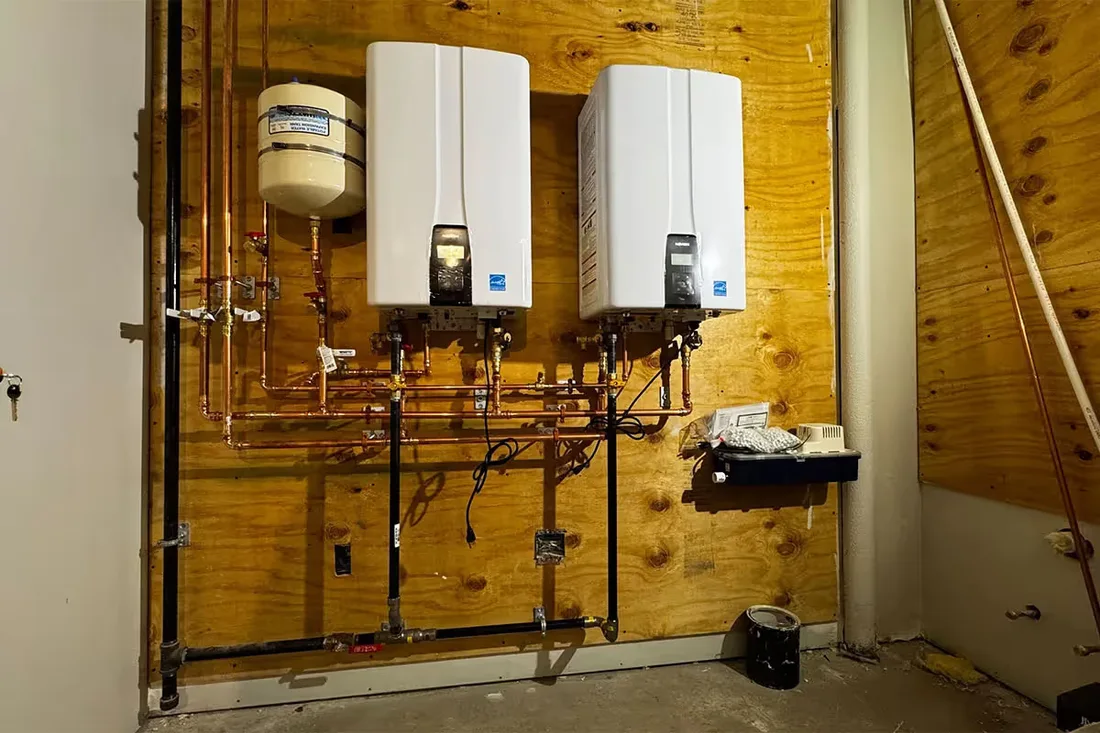
Service valves, sometimes called isolation valves, are a pair of valves installed on the cold inlet and hot outlet of the heater. Each has a main valve plus a small drain or purge port with a cap. With the main valves closed, the purge ports let someone connect hoses and circulate solution through the heat exchanger without cutting into the piping.
Without them, descaling becomes a bigger job. The water to the house may need to be shut off, connections may need to be opened, and there is more chance of disturbing fittings that have been in place for years. That is why many tankless installation instructions call for service valves, and why we ask whether your unit already has them. If it does not, adding them is often worth considering the first time the unit is serviced, so every future maintenance visit is simpler.
You can usually spot service valves just below the unit: two valves with handles (often one red and one blue or marked hot and cold) and a small capped port on each. A pressure relief valve is also commonly installed near the hot outlet. If you are not sure what you are looking at, a photo of the piping under the unit helps us a great deal.
Handling an error code
Tankless water heaters, including Navien models, run a series of checks every time they fire: flow, ignition, flame, exhaust temperature, water temperature, and more. When one of those checks fails, the unit stops heating and shows an error code. The code is a clue, not a diagnosis, but it is a very useful one.
What you can safely do
- Write down the exact code and the model number from the rating label on the unit. Take a photo of the display if you can.
- Look the code up in your owner's manual. Manufacturers publish code lists, and many explain which items a homeowner can check.
- Check the simple things. Is the gas or propane supply on? On a propane system, is there fuel in the tank? Is the unit plugged in and the breaker on? Is snow, ice, or debris blocking an outdoor vent or air intake termination?
- Note the pattern. Does the code appear every time, only during long showers, only at high flow, or only on cold mornings? That pattern can narrow down the cause.
What to avoid
- Don't keep resetting the unit. A single reset after a one-time hiccup is reasonable. A code that keeps coming back is telling you something is wrong, and repeated resets can hide the problem.
- Don't open the sealed combustion section or work on gas components yourself. That work belongs with a licensed professional.
- If you smell gas, do not operate switches or try to relight anything. Leave the house and call your gas or propane supplier from outside.
When you contact us, the code, the model number, and the pattern you noticed help us decide what kind of visit makes sense and what to bring.
How often should a tankless heater be serviced?
There is no single interval that fits every home. The right schedule depends on the manufacturer's guidance for your model, how hard your water is, how much hot water your household uses, and whether you have treatment equipment ahead of the heater. Homes with hard water and heavy hot-water use generally need descaling more often than homes with soft water and light use. Your owner's manual is the starting point, and a water test tells you how much hardness you are dealing with.
If your water is hard, a water softener sized from your test results can greatly reduce how quickly scale builds up in the heat exchanger. A sediment filter can help protect the inlet screen on a well with grit in the water. Treatment does not eliminate the need for inspection, but it can make descaling less frequent and the heater's job easier.
Local notes for Bolton and Vernon
Bolton. Bolton has a long-standing reliance on private wells, and well water carries sediment and dissolved minerals straight into a water heater. For a tankless unit, that means both the inlet screen and the heat exchanger deserve attention, and a water test is the best guide to whether a softener or filter would help. Census estimates also show that relatively few Bolton households heat with utility gas, so many tankless units in town run on propane. If yours does, keep an eye on the propane supply when troubleshooting, and make sure outdoor vent terminations stay clear through the winter. Our Bolton water heater page and Bolton water treatment page have more local detail.
Vernon. Many Vernon homes are served by Connecticut Water, whose Rockville treatment facility in Vernon treats water from Shenipsit Lake Reservoir. On a treated public supply, the supplier's annual water quality report is the place to start for hardness information. Vernon also has a lot of multi-family housing; if a tankless unit serves more than one household, plan a maintenance visit with the owner so the shutdown is coordinated. Some Vernon properties are on private wells, and the well advice above applies to them. See our Vernon water heater page and Vernon water treatment page for more.
Repair, maintain, or replace?
Maintenance is usually the right first step for a unit that is working but sluggish, or one that has not been serviced in a long time. If a unit has a persistent error code, a leaking heat exchanger, or repeated failures of the same part, the conversation may turn to repair or replacement. That decision depends on the unit's age and condition, the cost of the parts involved, and whether your hot-water needs have changed. If replacement is on the table, our post on tank vs. tankless water heater replacement walks through the options, and our water heater page covers tank models from A.O. Smith and State. For larger projects, financing through Wisetack is available, subject to credit approval.
What to tell us when you call
- The brand and model number from the unit's rating label.
- Any error code, and when it appears.
- Whether the unit runs on natural gas, propane, or electricity.
- Whether service valves are already installed below the unit (a photo is ideal).
- Whether you are on a private well or public water, and whether you have a softener or filter.
- Roughly when the unit was installed and last serviced, if you know.
NextGen Plumbing Co. is a family-owned, licensed and insured plumbing company based in Coventry, serving Bolton, Vernon, and nearby towns, with a one-year labor warranty. Call (860) 419-4111 Monday through Friday, 8:00 AM to 4:00 PM, or book online, and we will schedule as promptly as we can. You can also send a service request with photos of your unit.
Common questions
Does a tankless water heater need maintenance?
Yes. There is no tank to flush, but minerals in the water can build up as scale inside the heat exchanger, and sediment can clog the inlet screen. Periodic descaling and inspection, on the schedule your manufacturer recommends, helps the unit keep performing.
What does descaling a tankless water heater involve?
The unit is shut down and isolated with its service valves, then a small pump circulates a manufacturer-approved descaling solution through the heat exchanger through the valves' purge ports. The unit is then flushed with fresh water, the inlet screen is cleaned, and the heater is restarted and checked for proper operation and leaks.
What are tankless service valves, and do I need them?
Service (isolation) valves are a pair of valves on the cold inlet and hot outlet, each with a small purge port. They let the heater be isolated and flushed without cutting into the piping. Many tankless installation instructions call for them, and adding them can make every future maintenance visit simpler.
My Navien is showing an error code. What should I do?
Write down the code and the model number, look the code up in your owner's manual, and check simple items such as the gas or propane supply, power, and whether an outdoor vent is blocked. If the code keeps coming back after one reset, call us with the code and model rather than resetting it again.
How often should a tankless water heater be descaled?
It depends on the manufacturer's guidance for your model, your water hardness, and how much hot water you use. Homes with hard water and heavy use generally need it more often. A water test and your owner's manual are the best guides.
Will a water softener help my tankless water heater?
If your water is hard, a properly sized softener can greatly reduce scale buildup in the heat exchanger, which can make descaling less frequent. The right equipment depends on your water test results.
Do you service tankless water heaters in Bolton and Vernon?
Yes. NextGen Plumbing Co. is based in Coventry and serves Bolton, Vernon, and nearby towns Monday through Friday, 8:00 AM to 4:00 PM. Call (860) 419-4111 or book online, and we will schedule as promptly as we can.
Financing
We offer financing
Finance projects up to $25,000*
Prefer to pay over time rather than all at once? We’ve partnered with Wisetack to offer our customers flexible financing options. Prequalify for financing today.

*All financing is subject to credit approval. Your terms may vary. Payment options through Wisetack are provided by our lending partners. For example, a $5,500 purchase could cost $253.54 per month for 24 months, based on a 9.9% APR, or $1,833.33 per month for 3 months, based on a 0% APR. Offers range from 0 to 35.9% APR based on amount requested and creditworthiness. Not all merchants and lending partners participate in 0% interest programs. Terms range from 3 - 120 months and may vary based on merchant, lending partner, or transaction size. State interest rate caps may apply. No prepaid finance charges or participation fees. See additional terms at wisetack.com/faqs.