
Most people don’t think about their water heater until the shower runs cold or a puddle shows up in the basement. When the old unit has reached the end of its life, the easy move is to put the same kind of heater back in the same spot. Sometimes that is the right answer. But replacement day is also the best time to ask whether a different system would serve your household better for the next decade or more.
This guide walks through how storage-tank and tankless water heaters work, what matters for homes in Coventry and nearby towns like Tolland, Mansfield, Andover, Bolton, Columbia, and Hebron, and how brands such as A.O. Smith, State, and Navien fit in. It won’t give you prices, because every installation is different, but it will help you ask the right questions before you get a quote.
Repair or replace? Signs your water heater is near the end
Not every hot-water problem means you need a new heater. A failed heating element, thermostat, gas control, or igniter can often be repaired. Replacement usually makes more sense when:
- The tank itself is leaking. Water seeping from the body of a storage tank (not from a fitting or valve) usually means the inner lining has corroded through. That can’t be patched.
- You see rusty water from the hot side only. Discolored hot water can point to corrosion inside the tank, especially in an older unit.
- It rumbles, pops, or bangs. Sediment and mineral scale settle on the bottom of a tank. Water trapped under that layer boils and makes noise, and the heater works harder to do its job.
- It can’t keep up anymore. If your household has grown, or the heater is losing capacity to sediment, you may run out of hot water sooner than you used to.
- It is old and repairs keep adding up. When an aging unit needs one part after another, putting that money toward a new system is often the better use of it.
For a deeper checklist, read our post on the five signs your water heater is about to fail, or our guide to common water heater problems in Coventry. If you are not sure whether to repair or replace, that is exactly what an assessment from a licensed plumber is for.
How a storage-tank water heater works
A conventional water heater keeps a tank of water, commonly in the 40- to 80-gallon range for homes, hot and ready at all times. A gas or propane burner under the tank, or electric elements inside it, heat the water to the thermostat setting. When you open a hot tap, hot water leaves the top of the tank and cold water enters at the bottom to be heated.
A few parts matter for how long a tank lasts and how safely it runs:
- The anode rod is a sacrificial metal rod that corrodes so the steel tank doesn’t. When it is used up, the tank itself starts to corrode.
- The temperature and pressure (T&P) relief valve opens if temperature or pressure inside the tank gets too high. It must be piped to a safe discharge point.
- The first-hour rating, printed on the unit’s label and spec sheet, tells you roughly how much hot water the heater can deliver in an hour of busy use, starting with a full tank. It is a better sizing guide than tank size alone.
The trade-off with any tank is standby heat loss. The heater keeps reheating water that is just sitting there overnight or while you are at work. Modern tanks are better insulated than older ones, but some energy is always lost.
Tanks are simple, familiar, and usually the most straightforward swap, because the new heater can often use the existing water, fuel, and vent connections with modest changes. A.O. Smith and State both make a wide range of gas, propane, and electric tank models, which makes it easier to match the size and connections of the heater you already have.
How a tankless water heater works
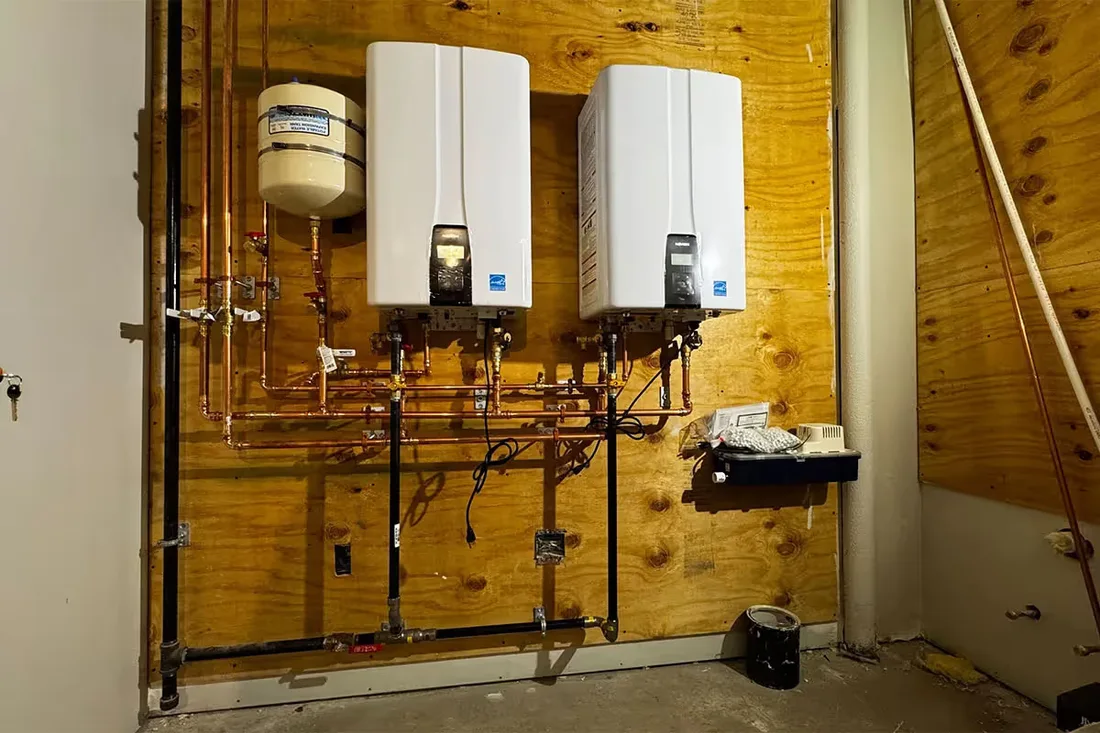
A tankless (on-demand) water heater has no storage tank. When you open a hot tap, a flow sensor detects the water moving, the burner fires, and water is heated as it passes through a heat exchanger. When you close the tap, it shuts off. Because nothing is kept hot while the house is idle, there is no standby loss from a tank.
Tankless capacity is measured in gallons per minute (GPM), not gallons stored. The key idea is temperature rise: how many degrees the heater has to raise the incoming water to reach your set temperature. The colder the water coming in, the more work the heater has to do, and the fewer gallons per minute it can deliver at full temperature. In Connecticut, incoming water is noticeably colder in winter than in summer, so a tankless unit should be sized for a cold January morning, not a mild September one.
Gas-fired whole-house tankless units, including Navien’s condensing models, have high burner input when they run at full fire. That often means checking whether the gas or propane line is large enough, and condensing units need a condensate drain and their own venting, typically plastic vent pipe run to an outside wall. Some Navien models also offer built-in recirculation options that can shorten the wait for hot water at faraway fixtures. Electric whole-house tankless heaters exist too, but they draw a large amount of current, so the home’s electrical service has to be able to support them.
Tankless heaters need regular maintenance as well. Scale from hard water builds up inside the heat exchanger, so most manufacturers call for periodic descaling (flushing). Service valves make that job much easier, which is one reason they are often part of a well-planned installation. Learn more on our tankless water heater installation and service page.
Tank vs. tankless at a glance
- Hot-water supply
- A tank delivers a stored supply that can run out during long, back-to-back use, then needs time to recover. A properly sized tankless unit keeps heating as long as demand stays within its flow rate.
- Simultaneous use
- Running two showers and the dishwasher at once can exceed a small tankless unit’s flow rate. Tanks handle short bursts well until the stored hot water is used up.
- Space
- Tankless units hang on a wall and free up floor space. Tanks need a footprint on the floor and clearance around them.
- Installation work
- A like-for-like tank swap usually reuses most existing connections. Converting from a tank to tankless often involves new venting, gas-line changes, a condensate drain, and new piping.
- Energy use
- Tankless heaters avoid standby losses from stored water. How much that matters depends on your household’s habits and fuel costs.
- Maintenance
- Tanks benefit from periodic flushing and anode checks. Tankless heaters need periodic descaling, especially with hard water.
- Upfront cost
- A tankless conversion typically costs more to install than a straight tank replacement, because of the extra work involved. Your written quote should show what is included.
What well water and hard water mean for your new heater
Many homes around Coventry, Andover, Columbia, and Hebron get their water from private wells, and hard water is common in well-water homes. Hard water carries dissolved calcium and magnesium that come out of solution when water is heated. In a tank, those minerals settle as sediment on the bottom. In a tankless heater, they can coat the narrow passages of the heat exchanger and reduce performance until the unit is descaled.
That doesn’t mean a well-water home can’t have a tankless heater. It means water quality should be part of the conversation. If you already have test results for hardness, iron, or pH, bring them. Depending on the numbers, a water softener or other water treatment may protect the new heater and the rest of your plumbing. If your home is on a well, it is also a good time to make sure the well system delivers steady pressure, since a tankless heater needs a minimum flow to fire reliably. Our guide to well pump and pressure tank repair in Coventry explains the common pressure problems and what they usually point to.
Choosing between A.O. Smith, State, and Navien
We install and service water heaters from A.O. Smith, State, and Navien. Each brand makes good equipment, and the right choice depends far more on your home than on the logo:
- A.O. Smith offers gas, propane, and electric tank water heaters, plus tankless and hybrid heat-pump models.
- State offers a broad line of residential tank water heaters in gas, propane, and electric versions.
- Navien is known for condensing gas tankless water heaters and also makes combination units that handle both home heating and hot water.
Whichever brand you choose, read the manufacturer’s warranty terms. Warranty coverage often depends on correct installation and following the maintenance schedule, which is another reason to plan for descaling or flushing from the start. NextGen also backs our own labor with a one-year warranty, and your quote explains how manufacturer coverage and our labor warranty work together.
Which one fits your home?
There is no single right answer, but these patterns come up often:
- A new tank often makes sense when you want the most direct replacement, your current setup works well apart from the failed heater, your household uses hot water in bursts, or you would rather avoid venting and gas-line changes.
- Tankless often makes sense when you want to free up floor space, your household regularly runs out of hot water from a tank, you plan to stay in the home long enough to value long-term efficiency, and the gas or propane supply and venting route can support the unit.
- A hybrid heat-pump water heater is a third option for some homes with electric water heating and the right basement space. Our post comparing traditional tanks and heat pump water heaters covers that choice.
The best way to decide is to look at your actual home: the fuel you have, the vent path, the electrical panel, the water quality, the number of bathrooms, and how your family uses hot water.
What a water heater replacement with NextGen looks like
- Assessment. We look at the existing heater, its water, fuel, vent, and electrical connections, the space, and your household’s hot-water needs.
- Options and a written quote. We explain the tank, tankless, or other options that fit, and your written quote spells out the equipment and work included, such as an expansion tank, drain pan, shutoff valves, or venting changes when they are needed.
- Removal and installation. We disconnect and remove the old heater when that is part of the scope, then install the new unit and its safety components.
- Start-up and walkthrough. We fill, start, and test the system, check for leaks, and show you the controls and the maintenance the manufacturer recommends.
Connecticut towns have their own building departments and permit rules, and water heater work often needs a permit. Ask about permits when you review your quote so you know what to expect. You can read more about how we approach this work on our water heater repair and installation page.
Paying for a new water heater
A water heater rarely fails at a convenient moment. If you prefer to pay over time, NextGen offers financing through Wisetack for projects up to $25,000, subject to credit approval. You can prequalify online, and the financing page explains how it works and lists the full terms.
Why homeowners call NextGen
NextGen Plumbing Co. is a family-owned, licensed and insured plumbing company based in Coventry, led by owner and master plumber Ralph Rejman, with more than 15 years of experience. We are rated 5.0 from 114 reviews on Google, and our labor comes with a one-year warranty. We serve Coventry and surrounding Connecticut towns, Monday through Friday, 8:00 AM to 4:00 PM.
If your water heater is showing its age, call (860) 419-4111 or book online. Tell us your town, the type of heater you have now, and what you have noticed, and we will talk through your options.
Common questions
How do I know whether to repair or replace my water heater?
A leak from the tank body, rusty hot water from an older tank, or a string of repairs on an aging unit usually point toward replacement. A failed element, thermostat, or gas control can often be repaired. A licensed plumber can inspect the heater and explain which option makes sense.
Can a tankless water heater keep up with a family in a Connecticut winter?
It can when it is sized correctly. Tankless output depends on how much the incoming water has to be heated, and incoming water is colder in winter, so the unit should be sized for winter conditions and for the number of fixtures your household runs at the same time.
Do I need a water softener before installing a tankless water heater?
Not always. Hard water is common in well-water homes and leaves scale in the heat exchanger, so share any water test results with us. Depending on the hardness, a softener or regular descaling, or both, may be recommended to protect the heater.
Can a tankless unit go where my old tank was?
Often it can go in the same room, but it mounts on a wall and usually needs different venting, a condensate drain for condensing models, and sometimes a larger gas or propane line. Those details are reviewed during the assessment and listed in your quote.
Which water heater brands does NextGen install?
We install and service water heaters from A.O. Smith, State, and Navien, including tank and tankless models. The right model depends on your fuel source, space, venting, and hot-water needs.
Do you offer financing for a water heater replacement?
Yes. NextGen offers financing through Wisetack for projects up to $25,000, subject to credit approval. You can prequalify online, and our financing page lists the full terms.
Financing
We offer financing
Finance projects up to $25,000*
Prefer to pay over time rather than all at once? We’ve partnered with Wisetack to offer our customers flexible financing options. Prequalify for financing today.

*All financing is subject to credit approval. Your terms may vary. Payment options through Wisetack are provided by our lending partners. For example, a $5,500 purchase could cost $253.54 per month for 24 months, based on a 9.9% APR, or $1,833.33 per month for 3 months, based on a 0% APR. Offers range from 0 to 35.9% APR based on amount requested and creditworthiness. Not all merchants and lending partners participate in 0% interest programs. Terms range from 3 - 120 months and may vary based on merchant, lending partner, or transaction size. State interest rate caps may apply. No prepaid finance charges or participation fees. See additional terms at wisetack.com/faqs.