
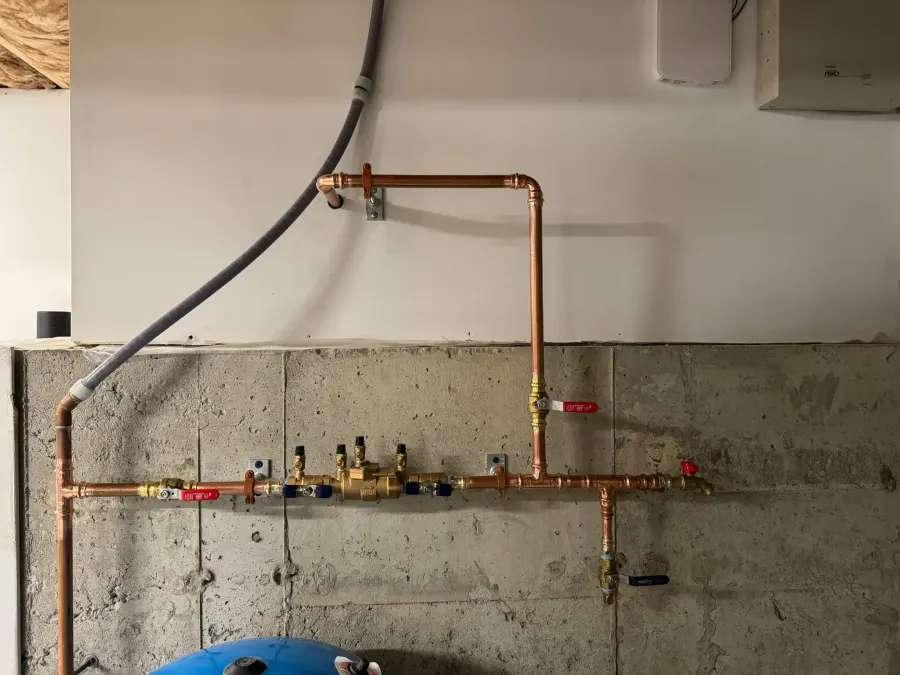
Signs you may have a leak
Some leaks are obvious: a drip from a fitting, a puddle under the water heater, a stain spreading across a ceiling. Others take a little detective work. Watch for:
- Water stains, bubbling paint, or soft spots on ceilings and walls below bathrooms or kitchens.
- A musty smell or damp insulation in a basement or crawl space.
- The sound of running water when every fixture is off.
- On a private well, a pump that kicks on when nobody is using water, or a pressure tank that cycles more often than it used to.
- On public water, a water bill or meter reading that climbs without a change in how you use water.
- Green or blue spots on copper pipe and fittings, or white crust around joints.
Why well homes in our area should pay attention
Many homes in Coventry and the surrounding Tolland County towns get their water from a private well. On a well, a leak doesn’t just waste water. It makes the pump run more often, which adds wear to the pump, pressure switch, and pressure tank. Catching a leak early protects that equipment as well as your floors and framing.
The Connecticut Department of Public Health notes that Connecticut’s groundwater is typically acidic, and low-pH water tends to be corrosive. Corrosive water can attack copper over time, which is one reason pinhole leaks show up in copper supply lines. If we find corrosion-related leaks, we’ll suggest a water test and explain whether an acid neutralizer is worth considering. That way you aren’t just patching one pinhole after another.
How we track down a leak
We start with the simple, non-destructive checks before anyone talks about opening a wall:
- Ask where and when you see water, and whether it follows a shower, flush, or appliance cycle.
- Isolate fixtures and branches with existing shutoff valves to narrow down which part of the system is leaking.
- Check exposed piping in basements, crawl spaces, and utility rooms, along with fixture connections, supply lines, and valves.
- Watch the meter or the well pressure gauge with fixtures off to confirm whether the supply side is losing water.
- Separate supply leaks (pressurized, always leaking) from drain leaks (only when water runs) so the right pipe gets repaired.
If the leak is hidden behind a finished surface, we explain the evidence and where access would be needed before any cutting happens. Who handles restoration of drywall, ceilings, or flooring is spelled out in the scope.
Pipe repair options
The repair depends on the material, location, and condition of the surrounding pipe. A single pinhole in otherwise sound copper may call for a short section replacement. A failed fitting or a corroded valve gets replaced. If several leaks appear along the same run, or the pipe is thin and pitted, it may make more sense to replace the whole section, or to talk about repiping. We handle copper, PEX, and the PVC and ABS drain lines found in most local basements. Your written quote confirms the work and materials before we start.
What you can do right now
If water is actively leaking, close the nearest fixture shutoff or the main shutoff. On a well system, the main valve is usually near the pressure tank; turning off the pump’s breaker also stops it from running. Move belongings away from the water, and take a few photos of the stain or drip. Photos help us prepare. Then call us at (860) 419-4111 to talk about availability.
What to tell us when you call
- Where the water appears
- Ceiling, wall, floor, or a specific fixture, and roughly when you first noticed it.
- When it happens
- All the time, or only when a shower, toilet, or appliance is used.
- Your water source
- Private well or public water, and whether the pump or meter seems to run more than usual.
Call (860) 419-4111 or request service online. Your written quote confirms the work and materials before anything starts.
Financing
We offer financing
Finance projects up to $25,000*
Prefer to pay over time rather than all at once? We’ve partnered with Wisetack to offer our customers flexible financing options. Prequalify for financing today.

*All financing is subject to credit approval. Your terms may vary. Payment options through Wisetack are provided by our lending partners. For example, a $5,500 purchase could cost $253.54 per month for 24 months, based on a 9.9% APR, or $1,833.33 per month for 3 months, based on a 0% APR. Offers range from 0 to 35.9% APR based on amount requested and creditworthiness. Not all merchants and lending partners participate in 0% interest programs. Terms range from 3 - 120 months and may vary based on merchant, lending partner, or transaction size. State interest rate caps may apply. No prepaid finance charges or participation fees. See additional terms at wisetack.com/faqs.
Find service information for your town
See the services available, local project considerations, and how to prepare for a visit.
Common questions
Can you find a leak without opening walls?
Often the source can be narrowed down from the symptoms, shutoff testing, and accessible piping. If the evidence points behind a finished surface, we explain where access is needed before any opening is made.
Why do I keep getting pinhole leaks in copper pipe?
Repeated pinholes can point to corrosive water, pipe age, or other conditions. We repair the leak and can discuss water testing and treatment so the cause is addressed as well as the symptom.
Does a leak repair include drywall or ceiling repair?
No. Plumbing repair and finish restoration are separate scopes. Your quote states what plumbing work is included and what restoration you will need to arrange.