What to know about water in Bolton
Bolton has long relied on private wells, so treatment equipment is an everyday topic here. Bolton is a member of the Eastern Highlands Health District, which oversees private wells and septic systems and publishes well-water resources.
On a well-and-septic property, where a softener or backwashing filter discharges is part of the plan, along with the space around the equipment and the bypass. We work that out before recommending a system, not after it arrives.
Public water or a private well?
A private well is your own water system, and only a laboratory test shows what is in it. Hardness, iron, manganese, and pH are the results that drive most equipment choices; the Connecticut Department of Public Health guidance for private well owners is a good overview of testing and treatment. Locally, the Eastern Highlands Health District is the health authority for private wells.
On a public system instead? Public water systems publish an annual Consumer Confidence Report with results for the whole system. It is useful background, but a problem limited to a few taps, or to hot water only, usually starts inside the house.
Softeners, neutralizers, iron filters, and filtration
- Acid neutralizers
- When a test shows acidic water, often noticed as blue-green staining or repeated pinhole leaks in copper, a neutralizer is one way to correct the pH. More about acid neutralizers.
- Iron filters
- An iron filter is chosen from the iron and related results plus the available flow. Staining alone doesn’t tell us which type will work. More about iron filters.
- Water softeners
- Softeners remove hardness minerals that leave scale on fixtures, in the water heater, and in a tankless heat exchanger. Sizing depends on hardness results and household use. More about water softeners.
- Whole-house filtration
- A whole-house filter housing on the main line can hold a sediment cartridge for grit or a carbon cartridge for some taste and odor issues. Cartridge size matters, because an undersized filter restricts flow. More about whole-house filtration.
We also offer annual maintenance for existing systems, and the overview of all our water treatment services explains how we plan a system.
Your pipes, your heater, and your water
The Census Bureau estimates that about 38% of Bolton’s homes were built before 1960. Older plumbing tends to have a mix of pipe materials and decades of mineral buildup, so we check the condition of the piping where new equipment ties in, and we talk about what the water may be doing to the pipes as well as to the fixtures.
If scale or sediment is already affecting your heater, see water heater service in Bolton.
Maintenance after installation
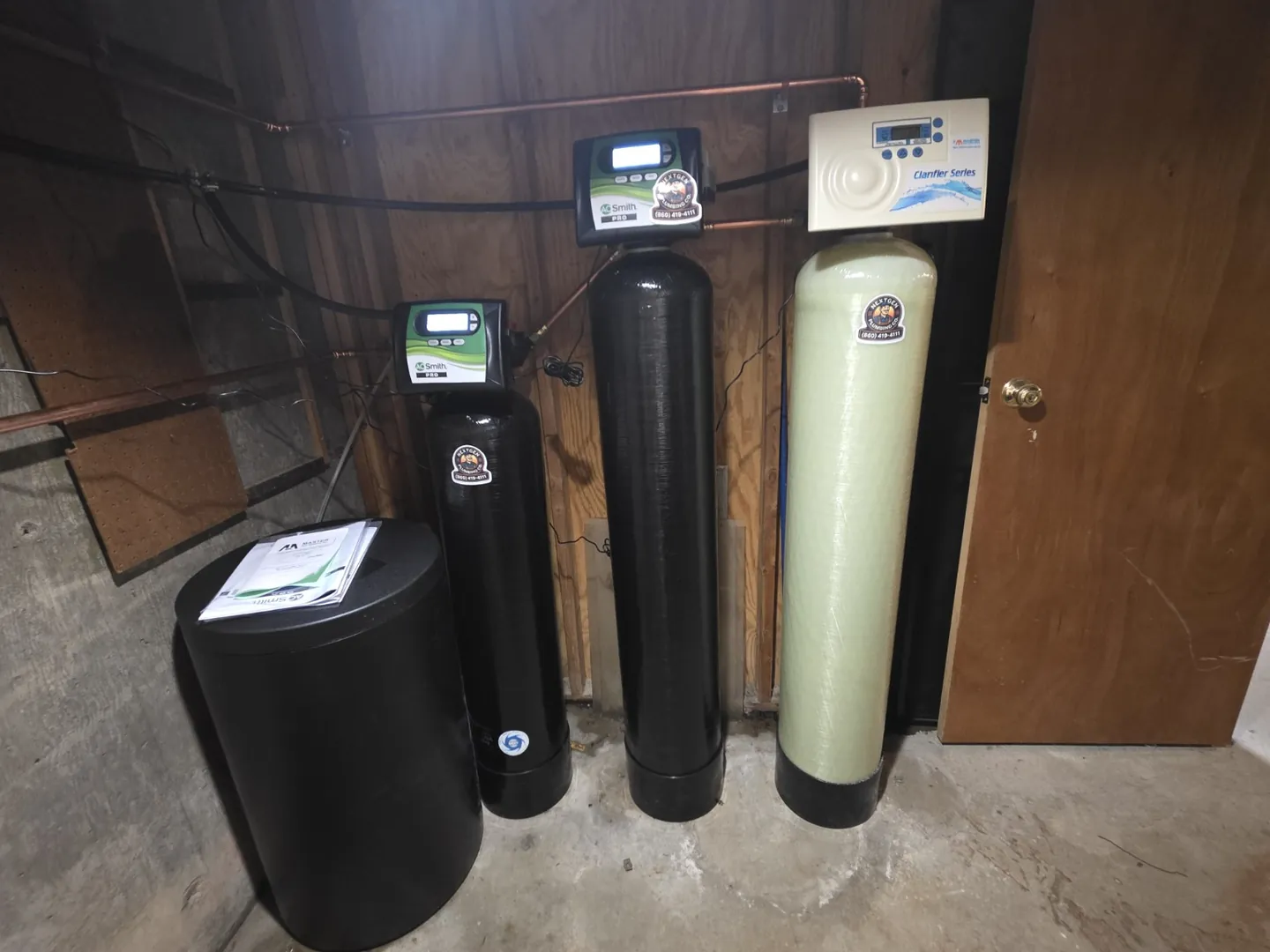
Most systems need some routine care: salt for a softener, media for a neutralizer, cartridges for filters, and periodic checks of the control valve settings. We can service multiple units in one maintenance visit, and salt or media are included only when listed in the scope.
Help us plan the visit
- People and use
- Household size and anything unusual, such as irrigation or a large tub.
- Test results
- A copy of the latest report, labeled raw or treated if you have both.
- Photos
- Every tank, the control heads, the bypass, and the space around them.
- Symptoms
- What changed and when: stains, scale, odor, taste, or pressure.
A local, licensed plumber
- Family-owned, licensed and insured; owner Ralph Rejman is a licensed master plumber, CT license PLM.0290797-P1.
- More than 15 years of plumbing experience.
- One-year labor warranty; manufacturer coverage varies by product.
- Rated 5.0 from 114 Google reviews.
- Financing through Wisetack for projects up to $25,000, subject to credit approval.
Bolton is about 5 miles west of Coventry, where NextGen is based. We schedule visits Monday–Friday, 8:00 AM–4:00 PM. Call (860) 419-4111 or book online through our Housecall Pro form, and include your address and a photo of the equipment if you can.
Questions from Bolton homeowners
Most Bolton homes have wells. Does every well need a softener?
No. A softener treats hardness. Low pH, iron, sediment, or other concerns need different equipment, and some wells need little treatment. A laboratory test tells you which, and we recommend equipment from those results.
What does an acid neutralizer do?
It raises the pH of acidic water, usually by passing it through a tank of calcite or a similar mineral that dissolves slowly. The media is replenished over time as part of maintenance.
Can I finance a water treatment system?
Yes. Wisetack financing is available for projects up to $25,000, subject to credit approval. See our financing page for details.
Financing
We offer financing
Finance projects up to $25,000*
Prefer to pay over time rather than all at once? We’ve partnered with Wisetack to offer our customers flexible financing options. Prequalify for financing today.

*All financing is subject to credit approval. Your terms may vary. Payment options through Wisetack are provided by our lending partners. For example, a $5,500 purchase could cost $253.54 per month for 24 months, based on a 9.9% APR, or $1,833.33 per month for 3 months, based on a 0% APR. Offers range from 0 to 35.9% APR based on amount requested and creditworthiness. Not all merchants and lending partners participate in 0% interest programs. Terms range from 3 - 120 months and may vary based on merchant, lending partner, or transaction size. State interest rate caps may apply. No prepaid finance charges or participation fees. See additional terms at wisetack.com/faqs.
Sources: 2020 census figures and geography via Wikipedia · U.S. Census Bureau, American Community Survey 2020–2024 5-year estimates: year built, median year built, house heating fuel · distance and direction from Coventry: straight line between Census Gazetteer interior points · Bolton Building & Land Use. Percentages are survey estimates and are rounded.