
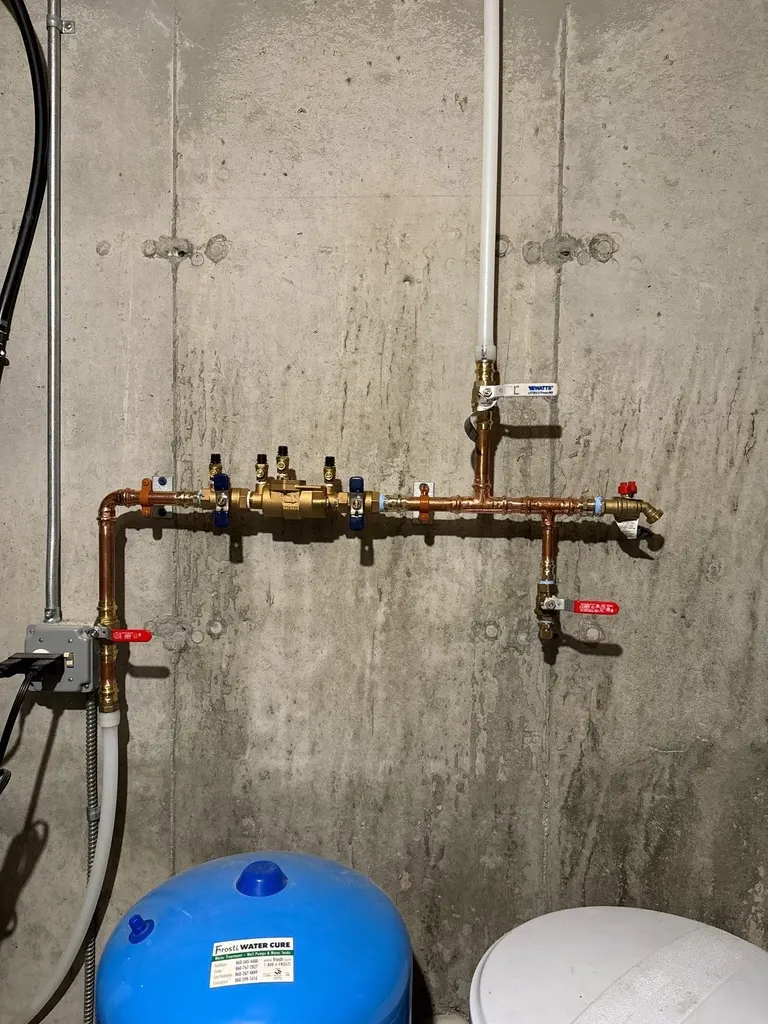
Is a pressure regulator right for your home?
It depends mostly on where your water comes from. Homes on a municipal or water-company supply, such as in Manchester, Vernon, East Hartford, and parts of other nearby towns, receive water at whatever pressure the system delivers to their street. Depending on elevation and location, that can be higher than household plumbing is designed for. A PRV on the incoming main lowers it to a steady, safe level.
Homes on a private well, which describes many houses in Coventry and other Tolland County towns, are different. A well system’s pressure is set by the pressure switch and pressure tank, so a well home typically doesn’t need a PRV on the main. If you’re on a well and having pressure problems, see our well systems service instead.
Signs your water pressure may be too high
- Banging pipes (water hammer) when a faucet or appliance valve closes quickly.
- Faucets that drip or toilets that run even after repairs.
- The water heater’s relief valve dripping or discharging.
- Appliance hoses or supply lines failing early.
- Showers and faucets that spray hard even when barely opened.
Pressure that suddenly rises in a home that already has a PRV often means the valve itself is wearing out. They don’t last forever.
How we test and what the numbers mean
We measure static pressure, with no water running, using a gauge at a hose bib or other connection. Many fixtures and appliances are designed for household pressure well below 80 psi, and plumbing codes generally call for a pressure-reducing valve when static pressure exceeds 80 psi. We’ll show you the reading and explain whether a new or replacement PRV makes sense.
What a PRV installation includes
Your written quote confirms the valve and the work. A typical installation covers:
- Installing the PRV on the main water line after the main shutoff, with unions or fittings that make future service easier where practical.
- Setting the outlet pressure and confirming it with a gauge.
- Checking how the change affects the water heater, including thermal expansion.
- Running fixtures and checking the new connections for leaks.
Don’t forget thermal expansion
When water heats up, it expands. Without a PRV, or a check valve or backflow device on the main, that extra volume can push back into the street supply. Once a PRV is installed, the home’s plumbing becomes a closed system and the expanding water has nowhere to go. Pressure spikes every time the water heater runs, which can make the relief valve drip. That’s why a properly sized water heater expansion tank usually goes hand in hand with a PRV. If you already have an expansion tank, we check it as part of the visit.
Low pressure is a different problem
If your pressure is too low rather than too high, a failed PRV is one possible cause, but so are clogged filters, corroded galvanized piping, partly closed valves, or supply issues. We’ll help narrow it down. For homes with old, restricted piping, repiping may be the longer-term answer.
Want the deeper explanation? Read our post on whether you really need a water pressure regulator.
What to tell us when you call
- Your water source
- Public water or a private well, and the water provider if you know it.
- The symptoms
- Banging pipes, dripping relief valve, running toilets, or sudden pressure changes.
- Existing equipment
- Whether you already have a PRV or a water heater expansion tank.
Call (860) 419-4111 or request service online. Your written quote confirms the work and materials before anything starts.
Financing
We offer financing
Finance projects up to $25,000*
Prefer to pay over time rather than all at once? We’ve partnered with Wisetack to offer our customers flexible financing options. Prequalify for financing today.

*All financing is subject to credit approval. Your terms may vary. Payment options through Wisetack are provided by our lending partners. For example, a $5,500 purchase could cost $253.54 per month for 24 months, based on a 9.9% APR, or $1,833.33 per month for 3 months, based on a 0% APR. Offers range from 0 to 35.9% APR based on amount requested and creditworthiness. Not all merchants and lending partners participate in 0% interest programs. Terms range from 3 - 120 months and may vary based on merchant, lending partner, or transaction size. State interest rate caps may apply. No prepaid finance charges or participation fees. See additional terms at wisetack.com/faqs.
Find service information for your town
See the services available, local project considerations, and how to prepare for a visit.
Common questions
Do I need a pressure regulator on a well?
Usually not. Well pressure is controlled by the pressure switch and tank. A PRV is typically used on homes supplied by public water.
How do I know if my PRV is failing?
Rising pressure, banging pipes, a dripping water heater relief valve, or noticeable pressure swings can all point to a worn valve. A pressure test confirms it.
Why does a PRV need an expansion tank?
A PRV creates a closed system, so heated water has nowhere to expand. An expansion tank absorbs that volume and keeps pressure from spiking.