
On town water, someone else treats the water before it reaches your house. On a private well, the water arrives exactly as the ground delivers it. For many homes that is perfectly good water, but it can also carry dissolved minerals that leave their mark on fixtures, glassware, and the water heater. The most common of those mineral problems is hardness, and the usual fix is a water softener.
This guide is for homeowners in Andover and Willington, and the nearby towns we serve from our home base in Coventry. We will explain what hard water is, how to tell whether you actually have it, how a softener works, and how one is sized, so the conversation about water softener installation starts with the right information.
What "hard water" actually means
Water hardness comes mainly from dissolved calcium and magnesium. As groundwater moves through soil and rock, it can pick up these minerals. They are not a health concern at typical levels, but they cause practical problems around the house once the water is heated or evaporates.
Lab reports and softener manufacturers express hardness in two common units:
- Milligrams per liter (mg/L), sometimes written as parts per million and usually reported "as calcium carbonate."
- Grains per gallon (gpg), the unit most softener sizing charts use. One grain per gallon equals about 17.1 mg/L.
The U.S. Geological Survey uses a simple scale: 0 to 60 mg/L is soft, 61 to 120 mg/L is moderately hard, 121 to 180 mg/L is hard, and more than 180 mg/L is very hard. If your report lists hardness in mg/L, divide by 17.1 to get grains per gallon.
Signs your water may be hard
Hard water tends to announce itself slowly. Common clues include:
- White or chalky crust around faucet aerators, showerheads, and the base of fixtures.
- Spots and film on glassware and dishes after the dishwasher runs.
- Soap and shampoo that do not lather well, and a sticky film or ring in the tub.
- Showerheads and aerators that clog and lose flow.
- A tank water heater that pops, crackles, or rumbles as it heats. Scale and sediment settling on the bottom of the tank are a common cause of that noise.
- Scale in a tankless water heater's heat exchanger, which manufacturers address with periodic descaling.
None of these signs proves hardness on its own. Staining in particular has several possible causes: orange or brown stains usually point to iron, black stains to manganese, and blue-green stains to acidic water attacking copper pipe. That is why the next step matters.
Start with a water test, not a guess
A softener is the right tool for hardness, and not for every other water problem. Before recommending one, we want to see a laboratory report that includes at least hardness, iron, manganese, and pH. Those four results decide most equipment choices.
The Connecticut Department of Public Health publishes guidance for private well owners on testing and on choosing treatment, and testing is done by a certified laboratory. Both Andover and Willington are members of the Eastern Highlands Health District, which is the local health authority for private wells and offers well-water resources for residents. If you already have a report, even an older one from when you bought the house, keep it handy and send it before the visit.
Two houses on the same road can test very differently, so a neighbor's results are useful background but not a substitute for your own. Our town pages for water treatment in Andover and water treatment in Willington explain which reports to start with.
How a water softener works
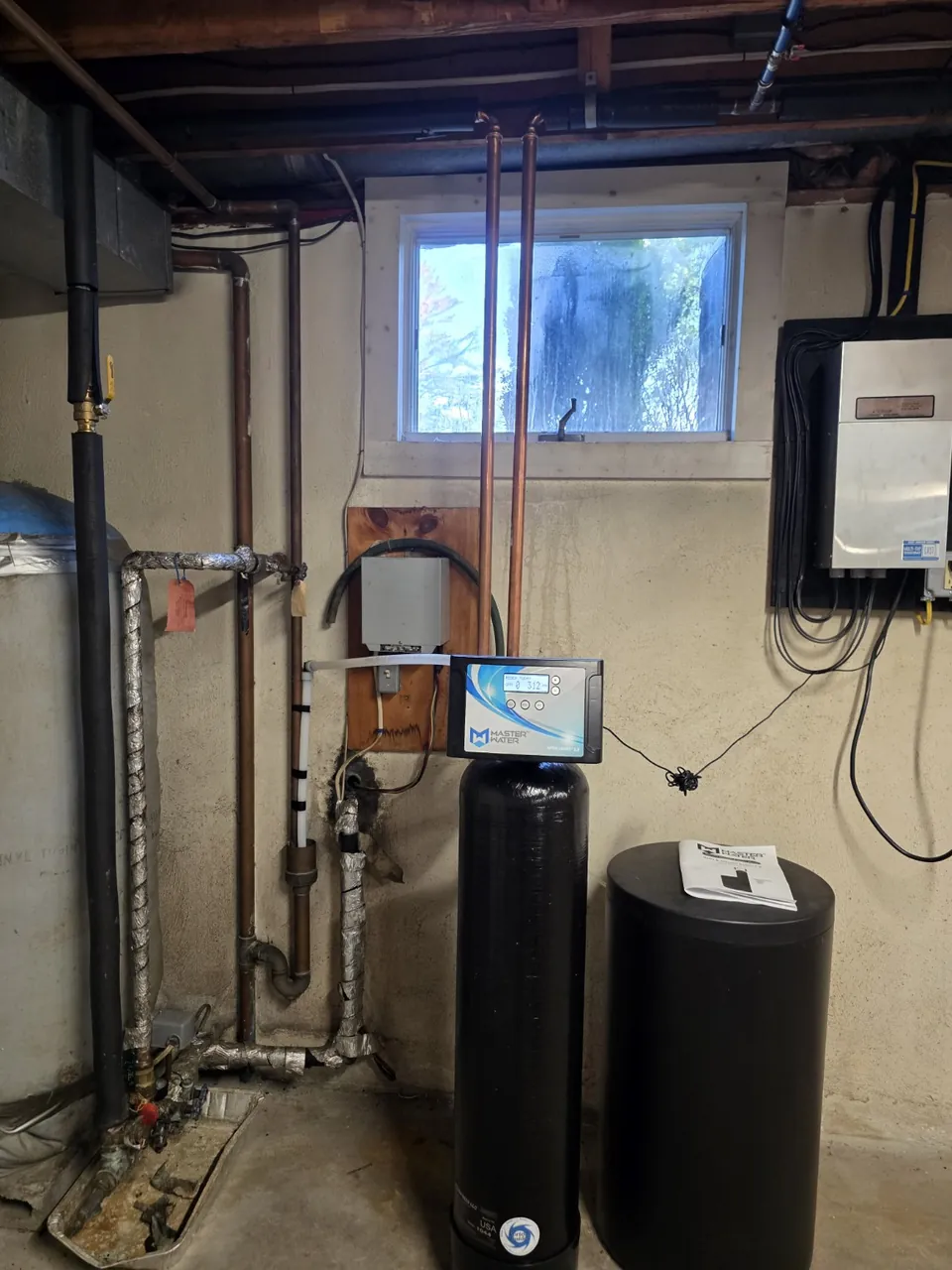
Most household softeners use a process called ion exchange. The system has two main parts:
- The resin tank. It is filled with small resin beads that hold sodium (or potassium) ions. As hard water passes through, the beads grab calcium and magnesium and release sodium or potassium in their place. Softened water continues on to the rest of the house.
- The brine tank. This is where you add salt. Over time the resin fills up with hardness minerals. During regeneration, the control valve draws salty brine from this tank through the resin, which knocks the calcium and magnesium off the beads and recharges them. The hardness minerals and leftover brine are rinsed down a drain line.
The control valve on top of the resin tank manages all of this. There are two common styles:
- Timer-based (time clock)
- Regenerates on a fixed schedule, whether or not the resin is used up. Simple, but it can waste salt and water when the household uses less water than expected.
- Metered (demand-initiated)
- Counts the gallons that pass through and regenerates only when the resin has softened about as much water as it can. For most households this uses less salt and water than a fixed schedule.
Regeneration usually runs at night when little water is in use, and a bypass valve lets you keep water flowing to the house if the softener ever needs service.
How a softener is sized
A softener that is too small regenerates constantly, uses more salt and water, and may let hard water through between cycles. One that is far too large can sit with water in the resin for long stretches between regenerations. Sizing comes down to a few numbers.
1. Your hardness, in grains per gallon
Start with the hardness result from the water report. When iron or manganese is also present, many manufacturers' sizing guides adjust the hardness figure upward, because those minerals also take up room on the resin. That adjustment follows the manufacturer's instructions for the specific unit.
2. How much water the household uses
Sizing guides typically estimate daily use from the number of people in the home. Many use an assumption somewhere around 60 to 80 gallons per person per day, but actual use varies a lot. A household with teenagers, a large soaking tub, or frequent laundry may use more; a couple who travel often may use less.
3. Grains removed per day
Multiply the two: people × gallons per person per day × hardness in gpg. As a purely hypothetical example, a four-person household using 75 gallons per person per day with water at 10 gpg would need to remove about 3,000 grains of hardness per day (4 × 75 × 10).
4. Capacity and days between regenerations
Softeners are sold by grain capacity, such as a "32,000-grain" or "48,000-grain" unit. That nominal number is usually the maximum, reached at a high salt setting. At the more economical salt settings most homes use, the usable capacity is lower, so the published capacity at your chosen salt setting is the figure that matters. Divide that usable capacity by daily grains removed to estimate how many days the unit will go between regenerations. Many installers aim for a regeneration every several days rather than every day or once a month, but the right target depends on the equipment.
5. Flow rate
Capacity is only half of sizing. The softener also has to pass enough water when several fixtures run at once without a noticeable pressure drop. A home with three bathrooms needs a different service flow than a one-bath cottage. On a well, the softener also sits after the pressure tank, so we look at the piping size, the existing pressure system, and any other treatment equipment in line.
These calculations are where a professional assessment earns its keep. We review your report, your household size and water habits, and the available space, then recommend a system from the products we install, including Master Water Conditioning and A. O. Smith equipment.
Softeners in well homes with other water issues
Well water often has more than one issue, and the order of the equipment matters.
- Acidic water (low pH). A softener does not raise pH. If the report shows acidic water, a pH neutralizer is the tool for that, and it is commonly installed ahead of the softener.
- Iron and manganese. A softener can remove small amounts of dissolved iron, but higher levels or other forms of iron can foul the resin. A dedicated iron filter is often the better choice, chosen from the iron results and the available flow.
- Sediment. Grit and sand can wear on control valves. A sediment filter ahead of the treatment equipment, part of whole-house filtration, can protect it. Keep in mind that a clogged cartridge can also make well pressure look weak; our well pump warning signs guide explains how to tell a filter restriction from a pump problem.
Our water treatment overview shows how we plan these systems together rather than one tank at a time.
Salt, sodium, and drinking water
Because ion exchange swaps hardness for sodium, softened water contains some added sodium. The amount depends on how hard the water was to begin with. If anyone in the home is on a sodium-restricted diet, talk with your doctor. Two common options are using potassium chloride in the brine tank instead of sodium chloride, or leaving a cold-water tap at the kitchen sink unsoftened for drinking and cooking. We can plan the piping for either.
Plan for the salt itself, too. The brine tank needs refilling on a regular basis, and the brine tank should be easy to reach. If the salt forms a hard crust (a "salt bridge") above the water, the unit can stop regenerating properly even though the tank looks full, so it is worth pressing on the salt occasionally to check.
Planning the installation
A softener is part of your plumbing, so the installation is planned around your house, not just the tank. Before recommending a system, we look at:
- Space for the resin and brine tanks, with room to add salt and service the valve.
- An electrical outlet for the control valve.
- A planned discharge point for the regeneration water. If your home is on a septic system, mention it so the drain arrangement can be discussed.
- A bypass and isolation valves so water stays on during service.
- The condition of the piping where the new equipment ties in, along with any existing treatment tanks and the well pressure tank.
- Whether hot water and outdoor spigots should be softened. Outdoor lines are often left unsoftened to save salt.
If you are replacing an existing softener, a replacement involves more than swapping a tank: we assess the existing piping, bypass, drain, and any adjacent equipment, and the written scope says which components are replaced and which are reused.
Notes for Andover homeowners
Andover is a small, rural Tolland County town of about 3,151 residents (2020 census) that borders Coventry, which makes it one of the closest towns we serve. According to Census Bureau estimates, about 37% of Andover's homes were built before 1960. In older homes we check the condition of the piping where new equipment ties in, and we look at what the water may already have done to the water heater and fixtures. If scale is already affecting your heater, our page on water heater service in Andover is a good next read. If your Andover home is on a private well, the Eastern Highlands Health District's well-water resources and a current laboratory report are the right starting point for a softener decision.
Notes for Willington homeowners
Willington is a Tolland County town of about 5,566 residents (2020 census), about 9 miles northeast of Coventry, with the Willimantic River along its western border. Census Bureau estimates show about half of Willington's homes were built before about 1976. For Willington well homes with existing treatment, we can review the softener, neutralizer, and iron filter as one coordinated system, and if flow drops after a filter change, we check whether the cause is the filter, the pressure system, or the piping before anything is replaced. See our Willington water heater page if scale has reached your heater.
Keeping a softener working
- Keep salt in the brine tank and check occasionally for a salt bridge.
- Confirm the settings after a power interruption, since some older timer valves lose the time of day.
- Re-test if things change. If spots and scale return, the hardness setting, the resin, or the water itself may have changed.
- Schedule routine service. Our annual water treatment maintenance can cover a softener, neutralizer, and iron filter in one visit; the quote lists the tasks and any salt or media included.
When to call
Call if you are seeing scale, spots, or soap problems and want to know whether a softener is the answer, if an existing softener has stopped working or uses far more salt than it used to, or if you are planning a new water heater and want to protect it. Have your water report, a count of the people in the home, the number of bathrooms, and photos of any existing equipment ready. You get a written scope before approved work begins, and we schedule as promptly as we can. For larger projects, financing through Wisetack is available for projects up to $25,000, subject to credit approval. You can also request service online.
Common questions
How do I know if I need a water softener?
Chalky scale on fixtures, spotty dishes, poor lather, and scale in the water heater are common signs, but a laboratory water report that shows hardness is what confirms it. We review the report along with iron, manganese, and pH before recommending equipment.
How is a water softener sized?
Multiply the number of people in the home by the estimated gallons per person per day and by the hardness in grains per gallon. That gives the grains removed per day, which is compared with the softener's usable capacity at its salt setting. Flow rate for the number of bathrooms matters too.
Will a water softener fix orange stains or blue-green stains?
Usually not by itself. Orange stains point to iron, which may need an iron filter, and blue-green stains point to acidic water, which a pH neutralizer addresses. A softener is designed for hardness.
Does softened water contain sodium?
Yes, ion exchange adds some sodium, depending on how hard the water was. If that is a concern, ask your doctor, and consider potassium chloride or an unsoftened drinking-water tap at the kitchen sink.
Do you install water softeners in Andover and Willington?
Yes. We are based in Coventry and install and maintain water softeners, acid neutralizers, iron filters, and whole-house filtration in Andover, Willington, and nearby towns, Monday through Friday, 8:00 AM to 4:00 PM. Call (860) 419-4111 to get on the schedule.
Does NextGen test my water?
We review results from a certified laboratory; our visit does not replace a laboratory test. Andover and Willington are both served by the Eastern Highlands Health District, which offers private-well resources.
Financing
We offer financing
Finance projects up to $25,000*
Prefer to pay over time rather than all at once? We’ve partnered with Wisetack to offer our customers flexible financing options. Prequalify for financing today.

*All financing is subject to credit approval. Your terms may vary. Payment options through Wisetack are provided by our lending partners. For example, a $5,500 purchase could cost $253.54 per month for 24 months, based on a 9.9% APR, or $1,833.33 per month for 3 months, based on a 0% APR. Offers range from 0 to 35.9% APR based on amount requested and creditworthiness. Not all merchants and lending partners participate in 0% interest programs. Terms range from 3 - 120 months and may vary based on merchant, lending partner, or transaction size. State interest rate caps may apply. No prepaid finance charges or participation fees. See additional terms at wisetack.com/faqs.