
If you live on a private well, you are the water company. Nothing is removed from the water before it reaches your tap, so whatever the groundwater picks up on its way through soil and rock comes straight into the house. Iron is one of the most common things it picks up, and it is one of the easiest to spot: orange or reddish-brown stains on porcelain, rust-tinted laundry, and a metallic taste in coffee and tea.
This guide is for homeowners in Ashford and Stafford, two large, largely rural towns where many homes rely on private wells, and for the nearby towns we serve from our home base in Coventry. We will cover what iron does, how to confirm it, the main types of iron filters, and what to think about before one goes into your basement.
What iron in well water looks like
Iron is not usually a health concern at the levels found in household wells. The U.S. Environmental Protection Agency treats it as a "secondary" contaminant, meaning the guideline is about taste, appearance, and staining rather than health. The EPA's secondary guideline for iron is 0.3 milligrams per liter (mg/L), and for manganese, a close relative that often travels with iron, it is 0.05 mg/L. Above those levels, people tend to start noticing problems.
Common signs of iron include:
- Orange, red, or brown stains in toilets, tubs, sinks, and around drains.
- Rust-colored spots or a dingy tint on white laundry.
- A metallic taste, especially in hot drinks, and sometimes a change in the color of brewed coffee or tea.
- Water that comes out clear but turns cloudy or orange after it sits in a glass or the toilet tank.
- Reddish sediment in the toilet tank, the water heater, or filter housings.
- Orange or brown slime inside the toilet tank, which can be a sign of iron bacteria (more on that below).
Black or dark brown stains point more toward manganese, and blue-green stains usually point to acidic water reacting with copper pipe. Those call for different solutions, which is one reason we never pick equipment from the color of a stain alone.
The different forms of iron
Iron shows up in well water in a few different forms, and the form affects how it is treated:
- Dissolved ("clear-water") iron
- Also called ferrous iron. Deep in the well, without oxygen, iron stays dissolved and the water looks clear coming out of the tap. Once it meets air, it oxidizes and turns into orange particles, which is why a clear glass of water can turn rusty after it sits.
- Oxidized ("red-water") iron
- Also called ferric iron. The iron has already oxidized into small particles, so the water looks tinted or cloudy right out of the faucet.
- Iron bacteria
- Naturally occurring bacteria that feed on iron and leave a slimy, rust-colored film, often seen inside the toilet tank. They are generally considered a nuisance rather than a health threat, but they can foul filters and plumbing and often need to be addressed along with the filter, for example with well disinfection.
Many wells have a mix of these, and the mix can change over time. Iron is also frequently found alongside manganese and, in some wells, hydrogen sulfide (the "rotten egg" smell). All of these affect which treatment will work.
Start with a lab test, not a guess
A stain tells you something is there. It does not tell you how much, in what form, or what else is in the water. Before we recommend an iron filter, we want to see a report from a certified laboratory that includes at least:
- Iron and manganese, in mg/L.
- pH, because many iron-removal media only work within a certain pH range, and acidic water may need a pH neutralizer first.
- Hardness, because a softener may also be part of the plan.
- Anything else the lab flags. The Connecticut Department of Public Health publishes guidance for private well owners on what to test for and how to choose treatment.
In Ashford, health-department services come from the Eastern Highlands Health District, which publishes well-water testing guidance for residents. In Stafford, start by confirming whether your home is on public water or a private well, since the answer decides which report to look at. Our town pages for water treatment in Ashford and water treatment in Stafford walk through where to begin.
Collect the sample the way the lab instructs, and if you already have a report from a home purchase, send it too. Older results are still useful background, even if a new test is a good idea.
How iron filters work
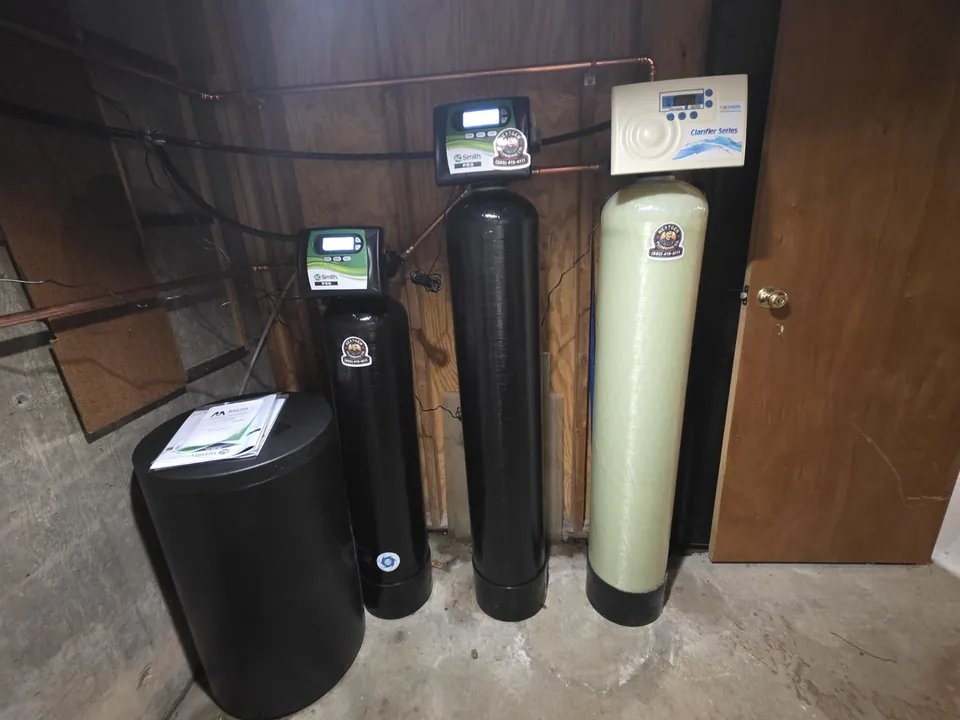
Most whole-house iron filters work in two steps: first they oxidize dissolved iron so it becomes a solid particle, then they filter those particles out in a bed of media. Periodically the filter backwashes, reversing flow to flush the trapped iron out through a drain line. The main differences between systems are how they handle the oxidation step.
Air-injection filters
These use oxygen to oxidize the iron, typically by keeping a pocket of air at the top of the tank that the water passes through. They avoid adding chemicals, which many homeowners like. How well they work depends on the iron and manganese levels, pH, and other chemistry, and on the manufacturer's operating limits for the specific unit.
Catalytic and oxidizing media filters
Some filters use a media bed that speeds up or carries out the oxidation itself. Different media have different requirements for pH, dissolved oxygen, and flow, and some need periodic regeneration with a chemical solution. The manufacturer's specifications for the media decide whether it suits a particular well.
Chemical-feed systems
For higher iron levels, iron bacteria, or a combination of iron, manganese, and sulfur odor, a system may inject an oxidizer such as chlorine or hydrogen peroxide ahead of a filter. These systems need more upkeep but can handle conditions simpler filters cannot.
What about a water softener?
A softener can remove small amounts of dissolved iron along with hardness, within the limits the manufacturer sets for that unit. It is not designed for oxidized iron or iron bacteria, which can foul the resin. Our guide to water softeners for well homes explains how softeners are sized and where they fit.
What decides the right filter for your home
Choosing an iron filter is less about the tank and more about the conditions around it. These are the factors we look at:
- Your water results. Iron and manganese levels, pH, hardness, and any odor all narrow the choices.
- Backwash flow from your well. A backwashing filter needs a certain flow rate for several minutes to clean its media. If the well pump and pressure tank cannot supply it, the media will not clean properly. That is why we look at the well system as part of the plan.
- Household demand. The filter has to pass enough water when several fixtures run at once without a noticeable pressure drop.
- A place for the backwash water. The filter needs a suitable drain. In Stafford, the town sewer plant serves only about a third of the town, mostly around Stafford Springs, and septic systems are the norm outside that district, so the discharge point needs to be planned. The same is true in rural Ashford homes on septic.
- Existing equipment. Many basements already have a softener, neutralizer, or sediment filter. The order matters: a neutralizer often goes ahead of an iron filter, and an iron filter usually goes ahead of a softener.
- Space and access. Room for the tanks, service clearance, an electrical outlet for the control valve where needed, and a bypass so water stays on during service.
We install equipment from Master Water Conditioning and A. O. Smith and select it around your results, household, and plumbing. The written quote spells out what is being installed, what stays, and what changes.
Notes for Ashford and Stafford homes
Ashford is one of the larger towns we serve by land area, at 39.5 square miles, and much of it is wooded, with parts of the Yale-Myers, Natchaug, and Nipmuck forests in town. In a rural town like Ashford, well equipment and treatment systems come up often. Many homeowners there move into a house with tanks they did not choose. Before replacing anything, photograph each tank, label, and control valve, and the piping between them. Equipment that was bypassed years ago or installed in the wrong order can make a good water report look like a treatment failure.
Stafford, at 58.8 square miles, is the fourth-largest town in Connecticut by area, and it includes the villages of Staffordville, Stafford Hollow, West Stafford, Crystal Lake, and Hydeville as well as Stafford Springs. Older homes in the mill villages may have older supply piping, and iron sediment can make existing low-flow problems worse. If you are fighting low flow along with staining, mention both; the water and the pipes may need separate fixes, and our repiping page explains that side.
Iron also settles in water heaters. If you see rusty hot water only, the cause may be the heater rather than the well, and the Stafford water heater page and Ashford water heater page cover what we check.
Keeping an iron filter working
- Let it backwash. Make sure the control valve has power and the correct time and settings, especially after a power outage.
- Watch for returning stains. If staining comes back, the media may be worn out, the backwash may be too weak, or the water may have changed.
- Keep up with any chemical feed. Systems that use chlorine, peroxide, or a regenerant need their supply checked.
- Re-test periodically. A follow-up test confirms the system is doing its job.
- Schedule routine service. Our annual water treatment maintenance can cover an iron filter, softener, and neutralizer in one visit, and the quote lists the tasks and any media included. For grit and sediment, see whole-house filtration.
When to call
Call if orange stains or a metallic taste have appeared or gotten worse, if an existing iron filter is not keeping up, or if you have just bought a home with treatment equipment you do not recognize. Have your water report, photos of the equipment and the space, and a count of the people and bathrooms in the home ready. Call (860) 419-4111 Monday through Friday, 8:00 AM to 4:00 PM, or book online. We schedule as promptly as we can, and you get a written scope before approved work begins. For larger projects, financing through Wisetack is available up to $25,000, subject to credit approval. You can also request service online.
Common questions
How do I know if I have iron in my well water?
Orange or reddish-brown stains, rusty laundry, a metallic taste, and water that turns orange after sitting are common signs. A laboratory test that reports iron and manganese in mg/L is what confirms it and shows how much is present.
Is iron in well water harmful?
At the levels typically found in household wells, iron is mainly a nuisance. The EPA lists it as a secondary contaminant with a guideline of 0.3 mg/L based on taste, staining, and appearance. Test for other contaminants too, as the Connecticut Department of Public Health recommends for private wells.
Will a water softener remove iron?
A softener can remove small amounts of dissolved iron within the manufacturer's limits, but it is not designed for oxidized iron or iron bacteria. Higher levels usually call for a dedicated iron filter, often installed ahead of the softener.
Why does my iron filter need a drain?
Most iron filters backwash on a schedule, reversing flow to flush trapped iron out of the media. That water has to go to a suitable drain, so the discharge point is part of the plan, especially in homes on septic.
Can my well supply enough water for an iron filter?
It depends on the pump, pressure tank, and the backwash flow the filter requires. We look at the well system and the filter's specifications together before recommending equipment.
Do you install iron filters in Ashford and Stafford?
Yes. We are based in Coventry and install and service iron filters, water softeners, acid neutralizers, and whole-house filtration in Ashford, Stafford, and nearby towns, Monday through Friday, 8:00 AM to 4:00 PM. Call (860) 419-4111 to get on the schedule.
Financing
We offer financing
Finance projects up to $25,000*
Prefer to pay over time rather than all at once? We’ve partnered with Wisetack to offer our customers flexible financing options. Prequalify for financing today.

*All financing is subject to credit approval. Your terms may vary. Payment options through Wisetack are provided by our lending partners. For example, a $5,500 purchase could cost $253.54 per month for 24 months, based on a 9.9% APR, or $1,833.33 per month for 3 months, based on a 0% APR. Offers range from 0 to 35.9% APR based on amount requested and creditworthiness. Not all merchants and lending partners participate in 0% interest programs. Terms range from 3 - 120 months and may vary based on merchant, lending partner, or transaction size. State interest rate caps may apply. No prepaid finance charges or participation fees. See additional terms at wisetack.com/faqs.