
Most water problems announce themselves with a stain. Orange points toward iron, white crust toward hardness, and blue-green toward something many homeowners have never heard of: acidic water. When water with a low pH runs through copper pipe, it slowly dissolves a little of the copper. That copper shows up as blue-green rings in sinks and tubs, and over years the pipe wall itself can thin until a pinhole leak appears.
This guide is for homeowners in Mansfield and Storrs and in our home town of Coventry, along with the rest of the towns in our service area. We will explain what pH means, the signs of acidic water, how to confirm it with a test, how a pH (acid) neutralizer works, and what to think about before one is installed.
What pH means, in plain terms
pH is a scale from 0 to 14 that describes how acidic or basic water is. A pH of 7 is neutral. Numbers below 7 are acidic, and numbers above 7 are basic (alkaline). The scale is logarithmic, so water at pH 6 is ten times more acidic than water at pH 7, and water at pH 5 is a hundred times more acidic.
The U.S. Environmental Protection Agency lists a recommended range of 6.5 to 8.5 for drinking water. That is a "secondary" guideline, which means it is about the water's effects on taste, appearance, and plumbing rather than a direct health limit. Below about 6.5, water is more likely to be corrosive to metal plumbing.
Groundwater picks up its character from the soil and rock it travels through. Water that moves through rock with little limestone has little natural buffering, and dissolved carbon dioxide can lower its pH. Private well water in parts of New England is often on the soft, acidic side for those reasons. That is a general tendency, not a rule: wells on the same road can test very differently, which is why we always start with your own water results.
Signs your water may be acidic
Acidic water is usually clear and may taste normal, so the clues tend to show up in the plumbing and fixtures:
- Blue-green stains in sinks, tubs, and toilets, especially below faucets and around drains.
- Pinhole leaks in copper supply pipe, sometimes more than one over a few years.
- A metallic or bitter taste, particularly in water that has sat in the pipes overnight.
- Green or blue tint on hair after washing, which some people notice when copper levels are high.
- Corroded fittings, green crust on valves and joints, or fixtures that wear out sooner than expected.
None of these proves low pH by itself. Blue-green staining can also come from other water chemistry, and pinhole leaks can have several causes, including water velocity, installation details, and the age of the pipe. The signs tell you to test; the test tells you what is going on.
Why acidic water matters
Your copper pipe
Copper is a reliable, long-lasting material, but it depends on a stable protective layer forming on the inside of the pipe. Acidic water works against that layer. The result can be gradual thinning of the pipe wall and, eventually, small leaks that show up behind walls, in ceilings, or in the basement. Treating the water reduces the ongoing corrosion, but it does not undo damage that has already happened. If you have active leaks, our leak detection and pipe repair service handles the repair, and for homes with widespread damage, our repiping page explains what replacing supply lines involves.
Metals in your drinking water
Corrosive water can carry dissolved copper to the tap, and in homes with older lead solder, brass fittings, or older fixtures, it can also carry lead. Lead-based solder was banned for drinking-water plumbing under the 1986 amendments to the Safe Drinking Water Act, so homes plumbed before that are the ones most worth asking about. The Connecticut Department of Public Health recommends that private well owners test their water and choose treatment based on the results. If you are concerned about copper or lead, ask the lab to include them, and follow the lab's instructions for a "first draw" sample if they recommend one.
Your other equipment
Low pH also affects water treatment. Many iron filters only work well within a certain pH range, so acidic water may need to be corrected first. Our guide to iron filters for well water explains how those fit together.
Start with a test, not a guess
Before we recommend a neutralizer, we want to see a report from a certified laboratory. A useful well-water report for this decision includes:
- pH, the starting point.
- Hardness, because a calcite neutralizer adds some hardness as it works (more on that below).
- Iron and manganese, because they affect what else the system needs and the order of the tanks.
- Copper and lead, if you have stains, leaks, or older plumbing and want to know what is reaching the tap.
Home test strips can hint at a problem, but a lab report gives the numbers equipment is chosen from. If you bought your home recently, look for the water test from the purchase; older results are still useful background, even if a new test is a good idea.
How a pH neutralizer works
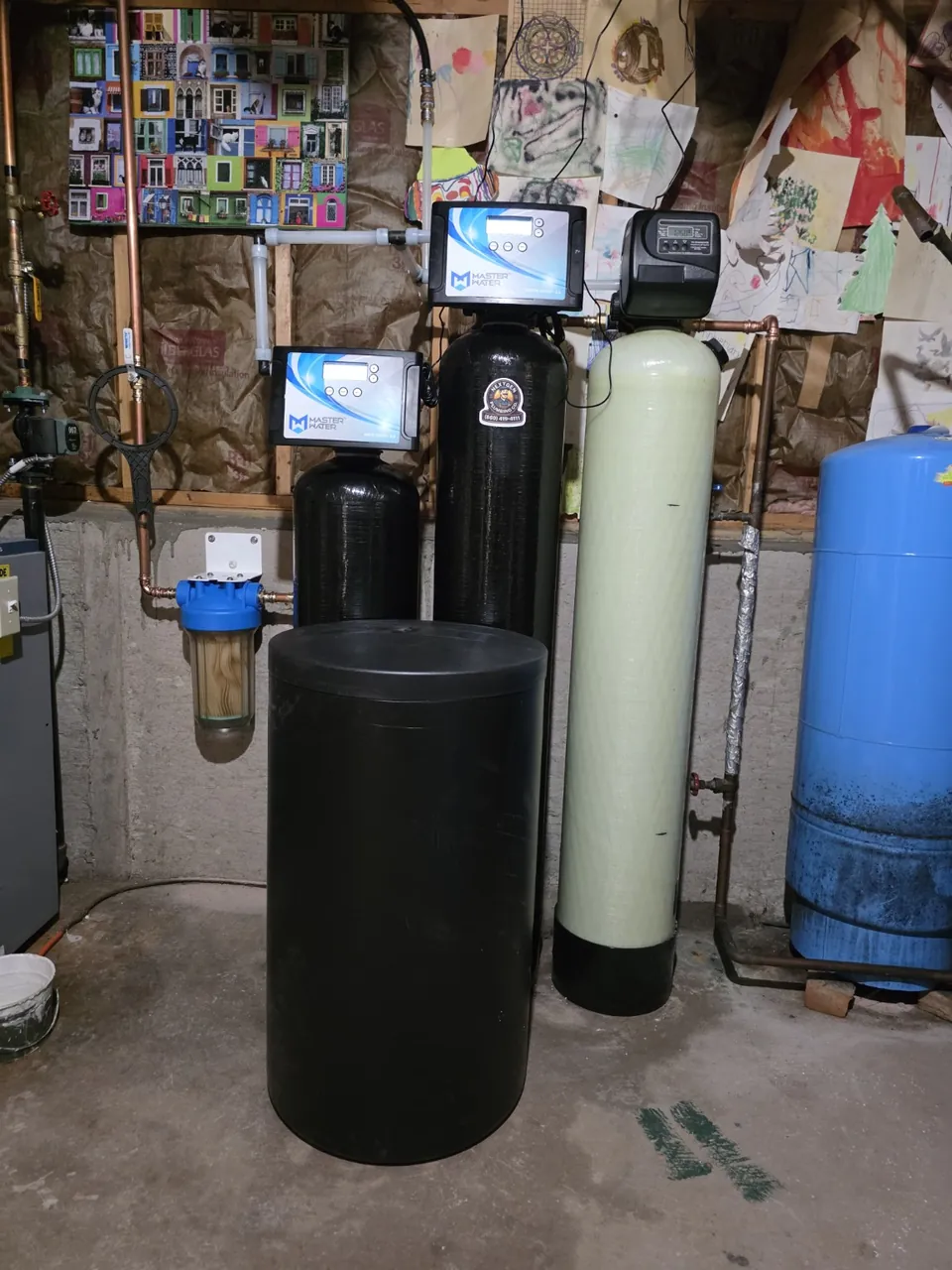
The most common whole-house neutralizer is a tank filled with calcite, which is crushed calcium carbonate (essentially a form of limestone). As acidic water flows through the bed, it slowly dissolves some of the calcite. That reaction raises the pH of the water. Because the calcite is consumed, the media level drops over time and has to be replenished.
A few points that matter in practice:
- Calcite for moderately acidic water
- Calcite is self-limiting: it dissolves less as the water approaches neutral, so it is difficult to overcorrect. Manufacturers publish the pH range their calcite media is designed for; water that is more acidic may call for a different approach.
- Blended media for lower pH
- For more acidic water, some systems blend calcite with a faster-acting magnesium oxide media. These blends raise pH more aggressively and need closer attention, because they can push pH higher than intended if the system is not set up and maintained correctly.
- Chemical feed for very low pH
- In some cases, a small pump injects a neutralizing solution, such as soda ash, into the water line. This handles conditions a media tank cannot, but it requires regular refilling and adjustment.
- Backwashing and upflow designs
- Many neutralizers use a control valve that periodically backwashes the media to keep it loose and clean, which needs a drain and enough flow from the well. Others are "upflow" designs that do not backwash. The right type depends on your water, flow, and plumbing.
Neutralizers and hardness: plan them together
When calcite dissolves, it adds calcium to the water. That is how it raises pH, and it also means the water leaving a neutralizer is harder than the water going in. For a home that already has soft, acidic water, the increase may be modest. For a home that also has moderate hardness, it can be enough to start leaving white scale on fixtures and inside the water heater.
That is why we read the pH and hardness results together. Some homes need a neutralizer and a water softener, installed in the right order: the neutralizer usually goes first, then the softener handles the added hardness. Our guide to how a water softener works and how to size one covers that side of the plan.
What decides the right system for your home
- Your water results. pH, hardness, iron, manganese, and any metals of concern narrow the choices.
- Flow and household demand. The tank has to keep up when several fixtures run at once, and a backwashing unit needs enough flow from the well to clean its media. We look at the well system as part of the plan.
- Existing equipment. If you already have a sediment filter, iron filter, or softener, the new tank has to fit into the sequence correctly. A neutralizer typically goes ahead of an iron filter and a softener.
- A place for backwash water. Backwashing units need a suitable drain. On a septic system, the discharge point is part of the planning.
- Space and access. Room for the tank, clearance to add media, an outlet for the control valve where needed, and a bypass so the house keeps water during service.
We install equipment from Master Water Conditioning and A. O. Smith, selected around your results, household, and plumbing. Your written quote spells out what is being installed, the media type, and what changes in your basement.
Notes for Mansfield and Storrs homes
Mansfield is a Tolland County town of about 25,892 residents (2020 census). It includes Storrs, home to the University of Connecticut's main campus, and the village of Mansfield Center. The town has both public-water service areas and private wells, so the first question for any Mansfield home is which one you are on. Connecticut Water serves customers in Mansfield. If you are on a public supply, the supplier's annual water quality report covers the system as a whole; if a problem shows up only at certain fixtures or only on hot water, the cause is more likely inside the building.
On a private well, your own lab report is what counts. Mansfield is a member of the Eastern Highlands Health District, the local health authority for private wells, and the town's rental-housing regulations include water-testing requirements for rentals served by private wells. If you own or manage a rental in Mansfield or Storrs, send us the water report, the written item that needs attention if it is part of an inspection, and the contact for whoever approves the work. Our plumbing work does not replace the town's inspection or a laboratory test.
Census estimates put about 55% of Mansfield homes as built before 1980. In older homes, it is worth looking closely at copper near fittings, the water heater, and faucet aerators, which are often the first places water chemistry shows. Our page on water treatment in Mansfield and Storrs explains how we plan a visit there, and water heater service in Mansfield and Storrs covers the heater side.
Notes for Coventry homes
Coventry is our home base, and water treatment and well systems are a regular part of our work here. If your Coventry home is on a private well, the same approach applies: test, read pH and hardness together, then choose equipment. If you are seeing low pressure along with water-quality problems, the well equipment may be part of the picture, and our page on well pumps and pressure tanks in Coventry covers what we check.
Keeping a neutralizer working
- Replenish the media. Calcite is consumed as it works. If the level drops too far, water passes through without enough contact time and the pH falls back.
- Watch for returning stains. New blue-green staining after treatment usually means the media is low, the system is bypassed, or the water has changed.
- Check the control valve. On backwashing units, confirm the valve has power and the correct time and settings, especially after a power outage.
- Re-test periodically. A follow-up test of treated water confirms the system is doing its job and that hardness is where you expect it.
- Schedule routine service. Our annual water treatment maintenance includes cleaning, system checks, and appropriate media top-offs, and can cover a neutralizer, softener, and iron filter in one visit. The quote confirms the media type and quantity for each unit.
When to call
Call if you have blue-green stains, a pinhole leak in copper pipe, a lab report showing low pH, or an existing neutralizer that you are not sure is still working. Have your water report, photos of the equipment and the space around it, and a note on any leaks ready. Call (860) 419-4111 Monday through Friday, 8:00 AM to 4:00 PM, or book online. We schedule as promptly as we can, and you get a written scope before approved work begins. For larger projects, financing through Wisetack is available up to $25,000, subject to credit approval. You can also request service online.
Common questions
What causes blue-green stains in my sink or tub?
Blue-green stains are usually copper dissolved from your pipes, which most often happens when the water is acidic (low pH). Other water chemistry can contribute, so a laboratory test that includes pH, hardness, and copper is the way to confirm the cause.
What pH is considered acidic for household water?
Anything below 7 is technically acidic. The EPA's recommended range for drinking water is 6.5 to 8.5, and water below about 6.5 is more likely to corrode copper and other metal plumbing.
Can acidic water cause pinhole leaks in copper pipe?
It can contribute. Acidic water gradually dissolves copper from the inside of the pipe, which can thin the wall over time. Pinhole leaks can have other causes too, so we look at the water results and the plumbing together. Treating the water does not repair pipe that is already damaged.
Will a pH neutralizer make my water harder?
A calcite neutralizer adds some calcium as it raises pH, so treated water is harder than untreated water. If your water already has moderate hardness, a softener installed after the neutralizer may also be needed.
How often does a neutralizer need new media?
It depends on your water chemistry, how much water the household uses, and the equipment. Calcite is consumed as it works, so the level drops over time. We offer annual maintenance that includes appropriate media top-offs, with the media type and quantity confirmed in the quote.
Do you install pH neutralizers in Mansfield, Storrs, and Coventry?
Yes. We are based in Coventry and install and service acid neutralizers, water softeners, iron filters, and whole-house filtration in Mansfield, Storrs, Coventry, and nearby towns, Monday through Friday, 8:00 AM to 4:00 PM. Call (860) 419-4111 to get on the schedule.
Financing
We offer financing
Finance projects up to $25,000*
Prefer to pay over time rather than all at once? We’ve partnered with Wisetack to offer our customers flexible financing options. Prequalify for financing today.

*All financing is subject to credit approval. Your terms may vary. Payment options through Wisetack are provided by our lending partners. For example, a $5,500 purchase could cost $253.54 per month for 24 months, based on a 9.9% APR, or $1,833.33 per month for 3 months, based on a 0% APR. Offers range from 0 to 35.9% APR based on amount requested and creditworthiness. Not all merchants and lending partners participate in 0% interest programs. Terms range from 3 - 120 months and may vary based on merchant, lending partner, or transaction size. State interest rate caps may apply. No prepaid finance charges or participation fees. See additional terms at wisetack.com/faqs.