Ellington homes and their water heaters
Ellington, about 11 miles northwest of Coventry, has the most varied mix of heating fuels in our service area: Census estimates show roughly a quarter of households on utility gas, a quarter on electricity, and more than a third on fuel oil. In practice that means two Ellington houses on the same road can have very different water heaters, so the first thing we confirm is the fuel and venting you already have.
Connecticut Water serves customers in Ellington, largely from its Rockville treatment facility in neighboring Vernon, and other homes are on private wells. Which one you have changes what we look at around the heater, from an expansion tank on a public supply to sediment and scale on a well.
What your water does to a heater
Ellington homes can be on a public supply or a private well, and the checks differ. On a public supply, we check static pressure and thermal expansion. If a pressure-reducing valve or check valve keeps heated water from expanding back into the main, an expansion tank may be required, and high pressure can make a relief valve drip. Our water pressure regulator page explains more.
On a private well, sediment and minerals reach the heater. In a tank, sediment settles on the bottom and can rumble as it heats; in a tankless unit, hardness can leave scale in the heat exchanger. A sediment filter, periodic flushing or descaling, and treatment chosen from a water test protect the heater. See our Ellington water treatment page.
How old Ellington’s homes are, and why it matters
According to American Community Survey estimates, the typical Ellington home was built around 1982, with about 22% of homes older than 1960 and about 48% older than 1980. Many of those homes are on their second or third water heater. The original utility space was sized for the heater of its day, so a larger tank, a heat-pump unit that needs airflow, or a wall-mounted tankless unit can change what fits and how it vents.
Repair or replace?
A failed thermostat, heating element, igniter, or flame sensor, or a dripping relief valve, is often repairable. A leaking tank is not: once the tank itself leaks, replacement is the fix. Between those, the heater’s age and condition and whether it still keeps up with your household decide it. We explain the trade-offs before you choose.
Which fuel will your new heater use?
The full breakdown from the Census Bureau’s American Community Survey: about 37% fuel oil, about 26% electricity, about 24% utility gas, about 8% propane (bottled or tank gas).
Fuel is only half the question; the other half is how the heater gets rid of exhaust. Chimney-vented tanks, sidewall power-vent tanks, and condensing tankless units with plastic vent pipe all have different requirements, and electric or heat-pump models trade venting for electrical capacity. That is part of every replacement quote.
Tank or tankless?
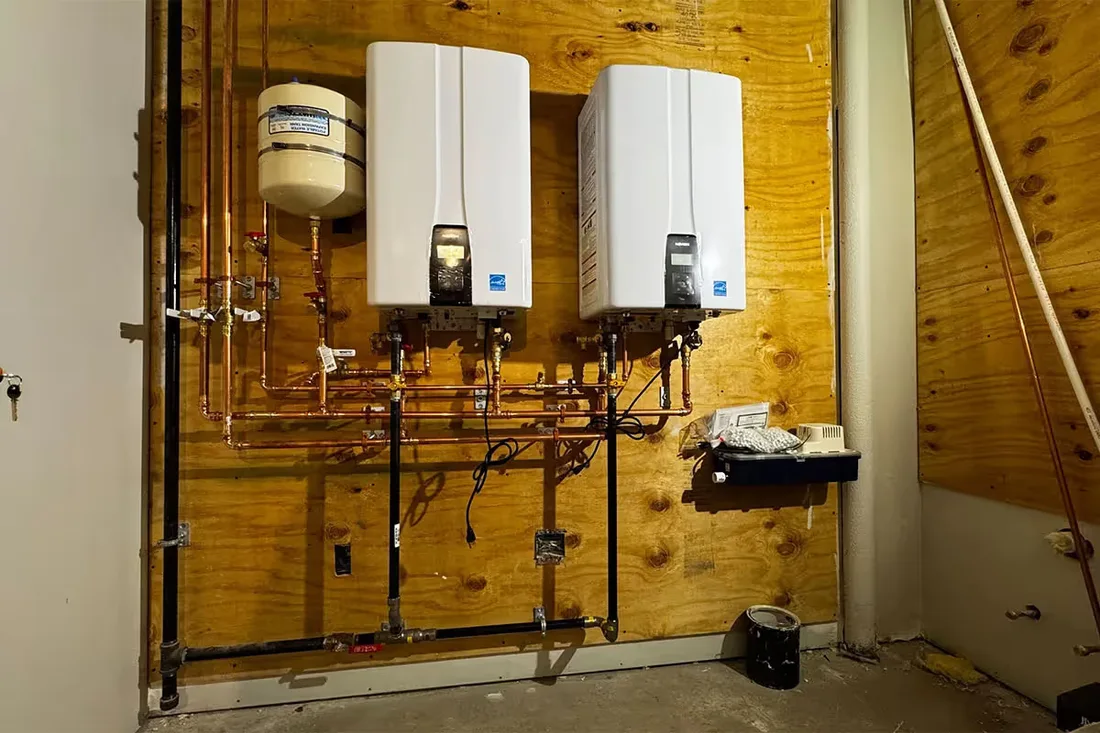
Tank or tankless is mostly a question of household demand, fuel, space, and venting. Navien tankless units save floor space and keep up with long showers, but they need the right gas or propane supply, a vent route, and a condensate drain, and they need periodic descaling on hard water. We compare both for your house; see our Navien tankless water heater page and our post on tank vs. tankless replacement.
Water heater work we do in Ellington
- Repair of electric and gas tank water heaters
- Replacement tank water heaters from A.O. Smith and State
- Navien tankless installation, replacement, and descaling
- Heat-pump (hybrid) electric water heaters
- Expansion tanks, relief valves, shutoff valves, and drain pans
- Removal of the old heater when it is in the scope
Your written quote confirms the exact work and materials. See all water heater repair and replacement services.
Questions from Ellington homeowners
My Ellington neighbor has a gas water heater. Can I get one too?
Only if gas service is available at your home or you add a propane supply. Census estimates show Ellington households split among gas, electric, and oil heat, so we confirm your fuel, venting, and electrical capacity before recommending a heater.
Do tankless water heaters need maintenance?
Yes. Depending on the model, the manufacturer’s guidance, and your water, a tankless unit may need periodic descaling and a check of its filters and venting. Service valves make descaling easier.
When can you come out to Ellington?
We work Monday through Friday, 8:00 AM to 4:00 PM. Call (860) 419-4111 or book online through our Housecall Pro form, and we will confirm a time.
Financing
We offer financing
Finance projects up to $25,000*
Prefer to pay over time rather than all at once? We’ve partnered with Wisetack to offer our customers flexible financing options. Prequalify for financing today.

*All financing is subject to credit approval. Your terms may vary. Payment options through Wisetack are provided by our lending partners. For example, a $5,500 purchase could cost $253.54 per month for 24 months, based on a 9.9% APR, or $1,833.33 per month for 3 months, based on a 0% APR. Offers range from 0 to 35.9% APR based on amount requested and creditworthiness. Not all merchants and lending partners participate in 0% interest programs. Terms range from 3 - 120 months and may vary based on merchant, lending partner, or transaction size. State interest rate caps may apply. No prepaid finance charges or participation fees. See additional terms at wisetack.com/faqs.
Brands we install & service



Brand names and logos are trademarks of their respective owners.
Sources: 2020 census figures and geography via Wikipedia · U.S. Census Bureau, American Community Survey 2020–2024 5-year estimates: year built, median year built, house heating fuel · distance and direction from Coventry: straight line between Census Gazetteer interior points · Ellington WPCA · Connecticut Water: Rockville facility. Percentages are survey estimates and are rounded.