
Connecticut winters are hard on plumbing. Overnight lows drop below freezing, wind pushes cold air into crawl spaces and garages, and outdoor faucets that worked fine in October can split by January if they still hold water. The good news is that most freeze damage is preventable. You do not need special tools or a full remodel—just a clear plan for outdoor faucets, exposed pipes, and shutoff valves before the first hard freeze settles in.
This guide is written for homeowners in Vernon and Ellington, and for the surrounding towns we serve from our home base in Coventry. It covers what to shut off, what to drain, what to insulate, and when it makes sense to call for plumbing repair instead of patching things yourself. It will not invent prices or promise outcomes we cannot control. It will help you walk through your house with a purpose.
Why Connecticut winters punish plumbing
Water expands when it freezes. Inside a copper, PEX, or galvanized pipe, that expansion has nowhere to go. The pipe, a fitting, or a faucet body can crack. Sometimes the break shows up right away as a spray of water when the ice thaws. Sometimes a hairline crack stays quiet until a mild day, when you finally notice a wet wall, a damp ceiling, or a puddle near an outdoor faucet.
Homes around Vernon and Ellington see a mix of housing ages and plumbing layouts. Vernon is the most populous town in Tolland County—about 30,215 residents across 18.1 square miles in the 2020 census—and includes the villages of Talcottville and Dobsonville plus the former City of Rockville. Ellington, with about 16,426 residents, was incorporated from East Windsor in 1786 and stretches from Ellington Center and Sadd’s Mill toward Crystal Lake and Shenipsit State Forest on its eastern side. Older homes, additions, and finished basements each create different cold spots: unfinished crawl spaces, rim joists, exterior walls behind outdoor faucets, and garages that share a wall with living space.
Public sewer serves much of Vernon through the town’s Water Pollution Control Department, and Ellington’s WPCA publishes guidance on sewer connections and water-treatment discharge. Winter prep is still mostly about the water supply side—faucets, valves, and pipes—rather than the drain system. Drains freeze far less often than pressurized supply lines, but a frozen outdoor faucet or a cracked pipe inside a wall is still a repair you would rather avoid.
Outdoor faucets: shut off, drain, and leave them open
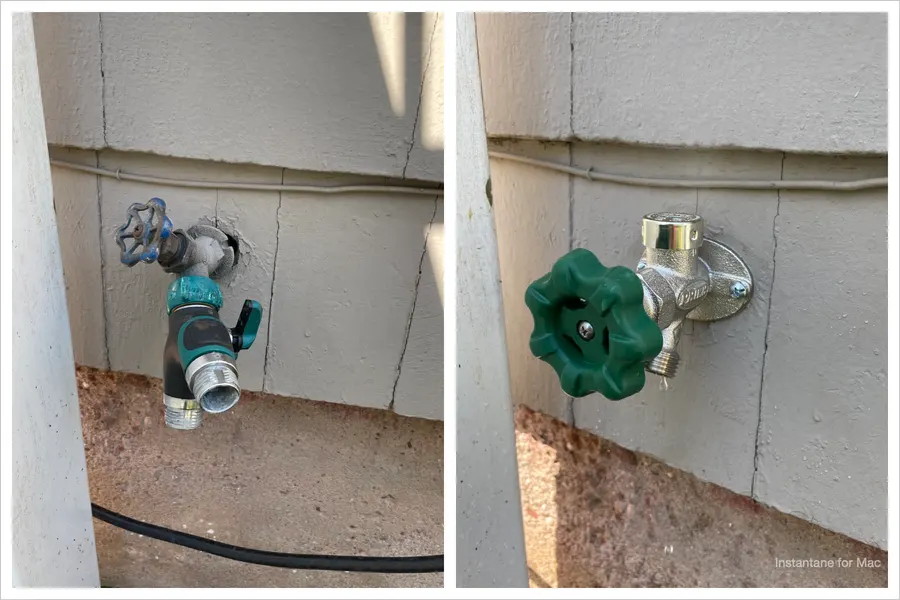
Outdoor faucets (hose bibbs or sillcocks) are the classic winter failure point. A garden hose left attached traps water in the faucet. Even a frost-proof sillcock can freeze and split if a hose, Y-splitter, or vacuum breaker holds water at the spout. Treat every outdoor faucet the same way before hard freezes arrive:
- Disconnect hoses and accessories. Remove every hose, splitter, sprinkler timer, and vacuum breaker. Store them indoors so they dry out.
- Find the indoor shutoff. Many homes have a small valve on the supply line that feeds each outdoor faucet, often in the basement or a utility closet near the exterior wall. Turn that valve off.
- Open the outdoor faucet and leave it open. With the indoor valve closed, open the outdoor faucet so any water between the shutoff and the spout can drain. Leaving it open also gives expanding ice somewhere to go if a little water remains.
- Drain the indoor side if there is a bleeder. Some shutoff valves have a small drain/bleeder screw. With a bucket underneath, open it so the stub of pipe empties completely, then close the bleeder again.
If you cannot find an indoor shutoff for an outdoor faucet, do not force a stuck valve. Note the location and plan a repair visit. A valve that will not turn, a faucet that never drains, or a frost-proof sillcock that weeps from the handle are all common plumbing repair items, and fixing them in the fall is far simpler than dealing with a split pipe after a freeze.
When an outdoor faucet is old, corroded, or mounted without a proper flange, replacement with a frost-proof sillcock is often the cleaner long-term fix. Frost-proof designs seat the valve deeper inside the warm wall cavity, so the water stops farther from the cold outdoor air—as long as nothing is left attached to the spout. If you are already updating fixtures, our faucet and fixture installation page covers how we approach outdoor and indoor faucet work.
Exposed pipes: find the cold spots before they find you
Walk the house with a flashlight and look for supply pipes that sit in cold air:
- Unfinished crawl spaces and rim-joist bays
- Garages with water lines for a sink, softener, or laundry
- Basement corners along exterior walls
- Utility rooms with thin exterior doors
- Pipes that pass through an unheated porch or mudroom
Foam pipe insulation is inexpensive and easy to slip over straight runs. Focus on the coldest stretches first—especially any pipe within a few feet of an outdoor faucet, a crawl-space vent, or a garage door. Seal large gaps around pipe penetrations so outdoor air is not blowing directly onto the line. Do not stuff insulation into a gas appliance vent or block combustion air; if you are unsure what a pipe or duct does, leave it alone and ask.
Heat tape (pipe heating cable) can help on a chronically cold run, but it must be the right type for the pipe material, installed exactly as the manufacturer specifies, and plugged into a suitable outlet with ground-fault protection where required. A loose wrap, a damaged cord, or heat tape on the wrong material is a fire and plumbing risk. If a pipe freezes every winter in the same spot, the lasting fix is usually better insulation, sealing air leaks, or relocating the run—not another layer of temporary protection.
Homes on private wells, which are common in parts of Ellington and nearby rural stretches, also need a quick look at the well equipment area. Pressure tanks and treatment gear are often in basements or utility rooms that stay above freezing, but any exposed supply line between the well and the house, or in a shallow crawl space, deserves the same insulation attention as indoor cold spots. If pressure drops, the pump short-cycles, or you hear sputtering after a cold snap, that points more toward the well system than toward an outdoor faucet—and it is worth a separate assessment.
Shutoff valves: know them before you need them
Winter prep is also the right time to confirm you can stop the water if something does go wrong. Every adult in the household should know:
- The main shutoff. It may be a ball valve or gate valve near where the water enters the house, at the water meter, or by the pressure tank on a well system. Know which way turns it off, and test that it moves without forcing it.
- Fixture shutoffs. Toilets, sinks, and some appliances have local stop valves. They let you isolate one fixture without shutting down the whole house.
- Outdoor-faucet shutoffs. As noted above, these are the first line of defense against freeze damage at hose bibbs.
- Water-heater shutoffs. Cold-water inlet valves and, for gas units, the gas supply valve are useful during heater service or if a tank starts to leak.
If a valve will not turn, drips when you move it, or the handle spins without closing, mark it and schedule a repair. Old gate valves in particular seize after years without use. Replacing a stuck main or outdoor shutoff on a planned visit is far better than discovering it during a freeze-related leak. For hidden moisture after a thaw, or a pipe that may have cracked inside a wall, see our leak detection and pipe repair page.
A practical pre-freeze checklist
Use this as a walk-through on a mild weekend before sustained freezing weather:
- Disconnect and store all outdoor hoses and accessories.
- Shut off and drain every outdoor faucet; leave the outdoor handles open.
- Insulate exposed supply pipes in crawl spaces, garages, and rim joists.
- Close crawl-space vents if your home uses seasonal vent covers (follow what is appropriate for your foundation type).
- Confirm the main shutoff works and show everyone in the house where it is.
- Check under sinks for slow drips you have been ignoring—cold weather and higher indoor heat can make small leaks worse.
- Test your sump pump before winter storms, and consider backup power if your basement relies on it. Our sump pump guide covers testing and backup options.
- Note any valve, faucet, or pipe that looks damaged, corroded, or impossible to shut off, and book a repair visit while schedules are open.
For the other end of the year, our spring plumbing checklist covers turning outdoor water back on, checking for winter damage, and getting irrigation and hose bibbs ready again.
What not to do when a pipe freezes
If a faucet runs weakly or not at all during a cold snap, a supply line may be frozen. A few rules keep a frozen pipe from becoming a broken one:
- Do not use an open flame. Torches and other open-flame tools are a fire hazard near framing, insulation, and soldered joints.
- Do not pour boiling water into a wall or onto an electrical area. Controlled warm air from a space heater (kept clear of combustibles) or a hair dryer on a visible pipe is the usual homeowner approach—only when you can see the pipe and stay with it.
- Open the faucet on the affected line so melting ice and steam pressure have a path out.
- Know where the main shutoff is before you start thawing. If the pipe has already cracked, water will move as soon as the ice melts.
If you cannot find the frozen section, if the pipe is inside a finished wall, or if you see moisture staining after a thaw, stop and call for help. Our post on signs you need plumbing repair and the guide to common plumbing mistakes and leak clues can help you describe what you are seeing when you reach out.
Vernon and Ellington details that affect winter service
A few local notes from our town pages help set expectations when you call:
- Vernon: Multi-family buildings are common in and around Rockville. If one fixture backs up, that often points to a local stoppage; if several fixtures back up together, the issue may sit farther down the shared drain. For outdoor faucet and supply-pipe freezes, the concern is usually limited to the unit’s own water lines, but access to shared mechanical rooms or crawl spaces can affect how a repair is scoped. Vernon’s Water Pollution Control Department runs the public sewer system; winter freeze damage is still almost always a private plumbing repair on the property side.
- Ellington: Neighborhoods from Ellington Center to the Crystal Lake panhandle include both sewer-connected properties and homes with private wells and treatment equipment. Ellington’s WPCA publishes guidance on sewer connections and on discharge from water-treatment systems. If you have a softener, neutralizer, or filter, winter prep should include confirming the unit’s drain line is protected and that the equipment room stays above freezing. Pressure changes after a cold snap can involve the well tank and controls rather than the outdoor faucet alone.
From Coventry, we schedule appointments across both towns during our regular business hours. When you contact us, share the town, whether the problem is an outdoor faucet, an exposed pipe, a valve that will not turn, or a leak after a thaw, and any photos of the fixture or mechanical area. That information helps us plan the visit around the actual layout.
When a repair visit makes more sense than DIY
Homeowners can handle hose removal, outdoor shutoffs that turn freely, and foam insulation on accessible pipes. Call for a licensed plumber when:
- An outdoor faucet has no indoor shutoff, or the shutoff is seized
- A frost-proof sillcock leaks at the handle or never drains
- You need a new outdoor faucet or valve installed correctly through the wall
- Pipes are hidden in finished walls, ceilings, or tight crawl spaces
- You find water stains, soft drywall, or a puddle after a freeze-thaw cycle
- A main shutoff will not close or drips when operated
NextGen Plumbing Co. is a family-owned, licensed and insured company based in Coventry, led by owner and master plumber Ralph Rejman (CT license PLM.0290797-P1), with more than 15 years of experience. We are rated 5.0 from 114 reviews on Google, and our labor carries a one-year warranty. We work Monday through Friday, 8:00 AM to 4:00 PM, across Vernon, Ellington, Coventry, and the rest of our service area.
Larger repairs—repipe sections, multiple faucet replacements, or damage that opens up walls—can be financed through Wisetack for projects up to $25,000, subject to credit approval. You can review terms on our financing page or prequalify online.
Ready to winterize or fix a problem faucet?
If you want help shutting off and draining outdoor lines, replacing a tired sillcock, freeing a stuck valve, or checking a pipe that took a freeze, call (860) 419-4111 or book online. Tell us you are in Vernon, Ellington, or another nearby town, what you have already tried, and the best hours to reach you during the work week. You can also use our contact form to send details and photos.
Common questions
When should I shut off outdoor faucets for winter in Connecticut?
Before the first hard freeze. In practice, many homeowners in Vernon and Ellington aim for late October or early November, once overnight lows regularly approach freezing. Disconnect hoses first, then shut the indoor valve and leave the outdoor faucet open to drain.
Do frost-proof outdoor faucets still need to be winterized?
Yes. Frost-proof sillcocks are safer because the valve seats inside the warm wall, but a hose, splitter, or vacuum breaker left attached can trap water at the spout and still cause a freeze break. Always remove accessories and confirm the line drains.
Where is the shutoff for my outdoor faucet?
Look on the supply pipe just inside the exterior wall—often in the basement, crawl space, or a utility closet. If you cannot find one, or the valve will not turn, a licensed plumber can locate it or install a proper shutoff and drain.
What should I do if a pipe freezes overnight?
Open the faucet on that line, keep the area safe, and warm only visible pipe with controlled warm air—never an open flame. Know where your main shutoff is in case the pipe has cracked. If the freeze is inside a wall or you see staining after it thaws, call for professional help.
Does NextGen serve Vernon and Ellington for winter plumbing repairs?
Yes. NextGen Plumbing Co. is based in Coventry and serves both Vernon and Ellington by appointment, Monday through Friday, 8:00 AM to 4:00 PM. Call (860) 419-4111 or book online with your address and a description of the faucet, valve, or pipe issue.
Can I finance outdoor faucet replacement or pipe repair?
For larger scopes, NextGen offers financing through Wisetack for projects up to $25,000, subject to credit approval. You can prequalify online, and our financing page lists the full terms.
Financing
We offer financing
Finance projects up to $25,000*
Prefer to pay over time rather than all at once? We’ve partnered with Wisetack to offer our customers flexible financing options. Prequalify for financing today.

*All financing is subject to credit approval. Your terms may vary. Payment options through Wisetack are provided by our lending partners. For example, a $5,500 purchase could cost $253.54 per month for 24 months, based on a 9.9% APR, or $1,833.33 per month for 3 months, based on a 0% APR. Offers range from 0 to 35.9% APR based on amount requested and creditworthiness. Not all merchants and lending partners participate in 0% interest programs. Terms range from 3 - 120 months and may vary based on merchant, lending partner, or transaction size. State interest rate caps may apply. No prepaid finance charges or participation fees. See additional terms at wisetack.com/faqs.